At a glance


Course duration
Course duration
14 Months

Master credits
Artificial Intelligence (AI) and Automation Practitioner Apprenticeship

Face-to-face events
Expert support from your personal Apprenticeship Tutor

Online learning
Access to cross-sector leadership resources & expertise

Coaching
Monthly Coaching
Sessions

Total learning hours
Programme cost
£18,000
 £0
with Apprenticeship Levy funding


What is the AI Practitioner Apprenticeship Level 4 for Local Government?


The AI Practitioner Apprenticeship Level 4 – For Local Government is a fully funded development programme designed for professionals working across local authorities and local government services who want to lead the practical, ethical and effective use of AI and automation to improve how services are delivered. It is built around the Level 4 Artificial Intelligence and Automation Practitioner apprenticeship standard and has been contextualised specifically for local government.

The programme focuses on reducing administrative burden, improving data quality and supporting safer, more efficient service delivery through responsible use of AI and low-code automation tools.

From early in the programme, learners identify a priority process, design a safe solution and implement improvements that deliver measurable impact such as time saved, fewer errors and clearer reporting. This means teams and services see benefits during the 14 months, not just at the end.


Which local government services and departments can benefit?

This apprenticeship has been designed to be valuable across local government, because every service relies on processes, data and systems that can be improved through safe, responsible use of AI and automation. It is suitable for colleagues working in, or supporting, services such as:

  • Adults and Children’s Services
  • Housing and Homelessness
  • Revenues and Benefits
  • Planning, Regulatory Services and Environmental Health
  • Customer Services and Contact Centre teams
  • Education, SEND and Early Help services
  • Highways, Transport and Place based services
  • HR, Finance, Legal and Corporate Services
  • IT, Digital, Data and Transformation teams

Which local government roles can benefit?

Local government relies on skilled practitioners who understand how services operate and can spot where processes, data and systems can work better. This apprenticeship is designed for colleagues who want to strengthen their ability to deliver practical, measurable improvement through the safe and responsible use of AI and automation.

If your role involves managing workflows, handling data, coordinating systems or leading service improvement activity, this programme will build your capability and confidence to make changes that stick. Typical roles include:

  • Service Managers and Team Leaders
  • Heads of Service and Operational Leads
  • Project, Programme or Transformation Officers
  • Business Analysts and Service Improvement Leads
  • Data, Systems or Digital Officers
  • Performance, Governance or Compliance Officers
  • Customer Services, Contact Centre or Casework Leads
  • Administrative or Business Support Staff with responsibility for systems and processes

What are the benefits of completing this programme?

  • Build confidence to use AI and automation safely, ethically and appropriately within a local authority context, with clear governance and oversight
  • Identify where workflows, forms, casework and administrative processes can be simplified, standardised and improved across services
  • Strengthen data quality and information flow to support clearer reporting, better operational oversight and more reliable management information
  • Design and manage practical low code automations using tools already common across councils, improving consistency and reducing avoidable rework
  • Lead change in a politically and operationally aware way, engaging colleagues, managing risk and supporting adoption within live services
  • Apply data protection, information governance and assurance principles when using AI supported tools, helping protect residents, staff and organisational credibility
  • Deliver a substantial workplace project that produces measurable service benefit, giving you clear evidence of what you improved and how you delivered it

How does the apprenticeship support governance and compliance?

Local authorities are not inspected on AI as a standalone issue. However, regulators, auditors and assurance bodies will consider how councils manage data protection, risk, governance, decision making and service performance. This apprenticeship has been designed to strengthen capability in exactly these areas.

UK GDPR


The Information Commissioner’s Office expects public bodies to demonstrate accountability, transparency and proportionate risk assessment when adopting new technologies. The programme trains apprentices to conduct structured risk and impact assessments, document decision making and ensure appropriate safeguards are in place before solutions move into live service environments.

ICO guidance


The Information Commissioner’s Office expects public bodies to demonstrate accountability, transparency and proportionate risk assessment when adopting new technologies. The programme trains apprentices to conduct structured risk and impact assessments, document decision making and ensure appropriate safeguards are in place before solutions move into live service environments.

Best Value and service improvement


Under the Best Value Duty, councils must demonstrate economy, efficiency and continuous improvement in service delivery. Every apprentice delivers a substantial workplace project that evidences measurable improvement, such as time saved, reduced duplication, improved reporting or strengthened process consistency, with monitoring and benefits realisation built into the later stages of the programme.

Governance and audit readiness


Councils are subject to internal audit, external audit and public scrutiny, requiring clear documentation and robust internal controls. The apprenticeship requires apprentices to maintain structured documentation including process maps, risk assessments, decision logs and impact reports, strengthening audit trails and organisational assurance.

Ethical and transparent use of AI


Public bodies are expected to act fairly, proportionately and transparently, particularly when technology influences decision making. The programme develops apprentices’ ability to evaluate fairness, proportionality and transparency before implementing AI-supported tools, ensuring technology supports professional judgement and public trust..

ICO guidance


Local authorities must actively manage operational, legal and reputational risk when introducing new systems or processes. Apprentices are trained to identify data, operational and bias-related risks, design appropriate controls and retain human oversight and escalation routes within automated or AI-supported workflows.


Am I eligible for this apprenticeship?

To be eligible for the programme, participants must:

  • be currently employed in a local authority or local government role
  • have a role that involves systems, data, operations or administrative responsibility
  • be able to complete a workplace project as part of the apprenticeship
  • have the right to work and study in England
  • have employer support to undertake the apprenticeship and off-the-job training

Programme content

  • Module 1: Foundations of AI, Automation and Digital Change (Months 1–2)
    This module builds confidence and a shared understanding of AI and automation in a local government context. Apprentices explore what AI is, how it is already being used across public services, and the professional, ethical and governance responsibilities that accompany it.

    The focus is on developing informed, proportionate judgement before any project work begins, ensuring technology supports service delivery rather than driving it.

  • Module 2: Process Mapping, Analysis and Opportunity Identification (Months 3–4)
    This module focuses on understanding how local authority processes operate in practice. Apprentices learn to map workflows, analyse inefficiencies and identify where automation could improve consistency, reduce avoidable administrative burden or strengthen service responsiveness.

    Potential project areas are explored with input from managers and stakeholders across the service or department.

  • Module 3: Data Analysis and Risk Assessment (Month 5)
    This module prepares apprentices to work confidently and responsibly with organisational data. It covers data readiness, information governance, UK GDPR, risk assessment and impact considerations within a public sector environment.

    By the end of this module, the workplace project is formally reviewed and approved, ensuring it is proportionate, compliant and aligned to service priorities.

From Month 6 onwards, learning is delivered through a live workplace project


From this point, the workplace project becomes the primary vehicle for learning and assessment. All remaining modules are applied directly to a real local government service improvement initiative.

  • Module 4: Low- and No-Code Development, AI Tools and Workflow Integration (Months 6–7)
    Apprentices design and build an initial automation or AI supported workflow using low or no code tools already available within their authority.

    This may include streamlining case management activity, improving internal approvals, simplifying reporting processes or reducing duplication across systems.

  • Module 5: Ethics, Governance and Compliance in Automation (Month 8)
    This module focuses on assurance and public accountability. Apprentices review their live project against governance frameworks, ethical standards and information governance requirements.

    Appropriate controls, transparency measures and human oversight are strengthened before any wider implementation.

  • Module 6: Testing, Assurance and Secure Implementation (Month 9)
    Apprentices test their solution thoroughly, gather feedback from colleagues and refine the approach before controlled release.

    The emphasis is on reliability, risk management and operational resilience, ensuring solutions are safe and workable within live services.

  • Module 7: Stakeholder Engagement, Change Management and Training (Month 10)
    This module supports effective adoption across services. Apprentices develop strategies to engage colleagues, provide structured training and manage change in a politically and operationally aware environment.

    The focus is on ensuring new tools are understood, trusted and used appropriately.

  • Module 8: Project Management, Monitoring and Professional Practice (Months 11–13)
    Apprentices monitor impact, measure service benefits such as time saved, reduced errors or improved reporting clarity, and refine their solution over time.

    This module focuses on professional accountability, evidencing impact and demonstrating value to managers and senior leadership.

Final Integrated Assessment and Sign-Off (Month 14)


The programme concludes with a final integrated assessment based on the workplace project, including a structured project review and professional discussion.

There is no standalone end point assessment event. Occupational competence is judged holistically across the full programme and the impact delivered within the service.

Programme Structure

How is the programme delivered?


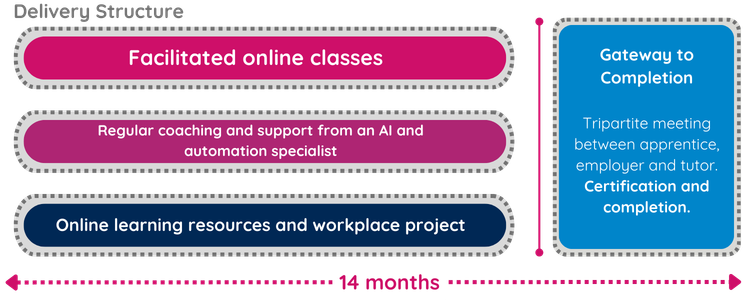
The AI Practitioner Apprenticeship Level 4 – For Local Government is delivered over 14 months through a blended model that combines live online learning, specialist coaching and a substantial workplace project. Learning and assessment are fully integrated, meaning apprentices demonstrate competence through real work carried out in their service, department or authority rather than a separate end point assessment.

Facilitated online learning sessions

Apprentices take part in regular, tutor led online sessions focused on the practical application of AI and automation in local government contexts. Sessions are designed to build understanding, share good practice and support apprentices to apply learning directly to their role, with a strong emphasis on ethical, responsible and safe use of AI within public services.

Specialist coaching and support

Throughout the programme, apprentices receive ongoing coaching and guidance from specialists with experience of AI, automation and digital change. Coaching supports apprentices to shape, deliver and refine a workplace project that addresses a real operational or service challenge within their local authority.

Online learning resources and e-portfolio

Apprentices have access to structured online learning materials to support their development between live sessions. Evidence of learning, reflection and project activity is captured through an e-portfolio, allowing assessment to take place naturally alongside day-to-day work.

Off-the-Job Training


Off the job training is structured learning that takes place outside of an apprentice’s usual, day to day work tasks, but during contracted working hours. It ensures that an apprentice has dedicated time to develop new knowledge, skills and behaviours relevant to their role. This kind of training must be meaningful, directly linked to the apprenticeship standard and documented so that progress is evident.

Examples of off the job training include coaching or mentoring sessions, formal training events, project work, reflective learning, research, shadowing, interactive online modules, networking and skill development activities.


Workplace project and integrated assessment

A substantial workplace project sits at the heart of the apprenticeship. Apprentices identify a priority service or operational process within their local authority, then design, implement and evaluate an AI or automation solution that delivers measurable improvement.

Projects typically focus on reducing avoidable administrative burden, improving the quality and flow of information, strengthening casework or workflow processes, or improving the consistency and reliability of reporting across a service area.

Assessment is integrated throughout the programme and is evidenced primarily through the workplace project. Rather than a standalone end point assessment, apprentices demonstrate occupational competence through the work they deliver, the decisions they document and the impact they can evidence in practice.

Gateway to Completion

Towards the end of the programme, the apprentice, employer and provider confirm that all requirements have been met through the Gateway to Completion.

Workplace project


What does the workplace project look like in practice?


At the heart of the apprenticeship is a substantial workplace project. This is not an add on task or a hypothetical exercise. It is the primary vehicle for learning, application and assessment.

From Month 6 onwards, the apprentice leads a live improvement project within their local authority, service or department. The majority of the programme is assessed through this project, with evidence drawn naturally from day to day work such as process maps, data and risk assessments, implementation plans, training materials, governance documentation and impact reports. There is no separate End Point Assessment. Success is demonstrated through the quality, assurance and measurable service improvement delivered by the project itself.

The project is not imposed. It is carefully scoped in collaboration between the apprentice, their line manager and the training provider during the early months of the programme. Together, you identify a priority area where improvement will deliver meaningful benefit, whether that is reducing avoidable administrative burden, improving the quality and flow of information, strengthening compliance and assurance, supporting more consistent decision making or streamlining internal workflows.

Projects must meet the knowledge, skills and behaviours set out in the apprenticeship standard, but within that framework local authorities have flexibility to choose what will make the greatest difference in their own context. The result is development that is professionally rigorous, grounded in public sector values and immediately useful to the service area where the apprentice works.

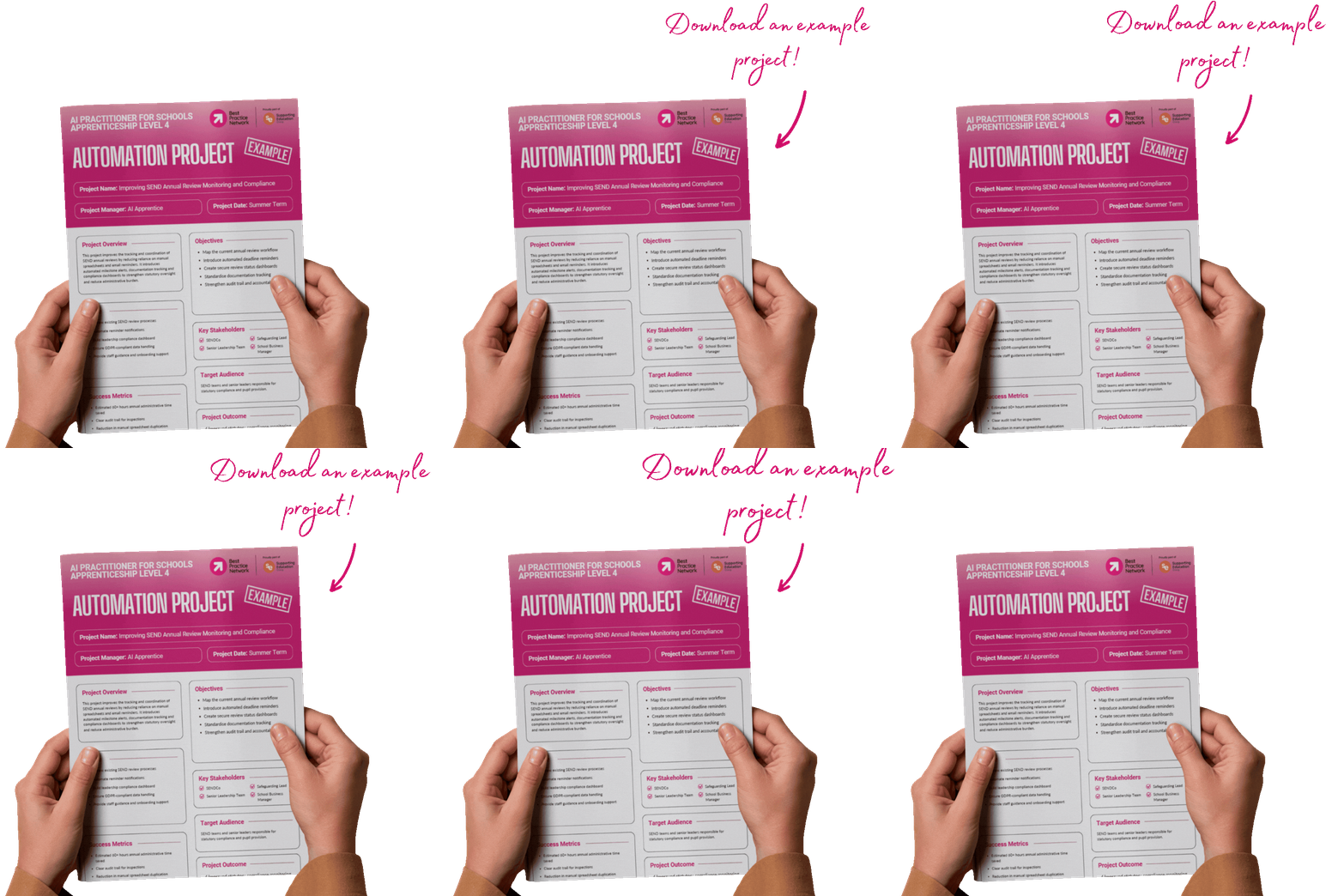
Example projects


Click to download

Example 1: Improving SEND Annual Review Monitoring and Compliance

Example 2: Automating Staff Onboarding and Pre-Employment Compliance

Example 3: Enhancing Behaviour Monitoring and Escalation Processes


"Having completed a number of professional qualifications during my time as a teacher, I have found this course to be the one that most clearly impacted upon my practice. I am very grateful to my Course Tutor for their advice, support and listening ear over the time of the course.

- Apprenticeship Graduate

Related Courses and Content