

Become a Primary Teacher
Train to teach in a local primary school with one of the country’s leading teacher training providers. Depending on your circumstances, you can choose between a salaried Teacher Apprenticeship or a fee-funded Teacher Training route.
Applications are now open for a 2027 start. Register your interest below to receive the application link for your chosen specialism.
.png)
Train to become a qualified primary teacher with Best Practice Network
To become a qualified primary teacher in England, you'll need to complete an approved teacher training programme that leads to Qualified Teacher Status (QTS). QTS is the recognised qualification required to teach in primary schools across England.
Choose your primary teacher training specialism:
- Primary ages 3–7: Train to teach children in the Early Years Foundation Stage (EYFS) and Key Stage 1, supporting children during the crucial early stages of their education.
- Primary ages 5–11: Train to teach children across Key Stage 1 and Key Stage 2, developing the skills needed to support pupils throughout primary school.
We offer two training pathways to help you start your teaching career:
Fee-Funded Initial Teacher Training
Best Practice Network’s Fee-Funded Initial Teacher Training (ITT) is a school-centred teacher training programme that leads to Qualified Teacher Status (QTS), the qualification needed to teach in schools across England.
Designed for those who hold a bachelor's degree and want to become qualified teachers, our school-based programme combines academic study with extensive classroom experience.
From the very beginning of your training, you will be based in a local school 4 days a week, learning directly from experienced teachers and putting theory into practice in real classroom settings.
Why choose Fee-Funded Initial Teacher Training?
- Turn your degree into QTS in just 11 months
- Train in the classroom from day one
- Join a national network of student teachers across England
- Receive expert support from experienced school mentors, a personal tutor and wellbeing team.
- Once qualified, start on a minimum salary of £32k (dependent on location)
Postgraduate Teacher Apprenticeship
The Postgraduate Teacher Apprenticeship is a school-based teacher training route for anyone who holds a bachelor's degree and is employed in a school. It's designed for aspiring teachers who want to gain practical classroom experience while earning a salary and working towards becoming a qualified teacher.
This salaried pathway allows you to learn on the job, with all training costs covered through your school's Growth and Skills Levy, meaning there are no tuition fees for you to pay.
On successful completion of the programme, you will achieve:
- Qualified Teacher Status (QTS)
- A Level 6 Teacher Apprenticeship Qualification
Why choose the Postgraduate Teacher Apprenticeship?
- Learn in the classroom from day 1
- Become a qualified teacher in just 10 months + Apprenticeship Assessment
- Earn a yearly salary of at least £23k while you learn
- Training costs covered by the Growth and Skills Levy
- School-Centred Initial Teacher Training (SCITT) (Learn more)
-
Once qualified, start on a minimum salary of £32k (dependent on location)
.png)
Entry Requirements
To be eligible for any of our teacher training routes, you will need:
- A bachelor’s degree (or equivalent) in any subject with a minimum 2:2 classification*
- GCSE grade 4/C or above in English and mathematics (or equivalent)
- GCSE grade 4/C or above in science if applying for Primary or SEND
- The right to study and work in the UK
Additional requirements for PGTA:
- Applicants must have held residency in the UK for the last three years
- Applicants must have a valid visa covering the full duration of the programme
*Qualifications achieved outside the UK (including Ireland) will need to be verified through UK ENIC with a comparability statement.
How Can I Fund my Teacher Training?
Fee-Funded Initial Teacher Training
From the start of the 2026/27 academic year, tuition fees for this programme will be £9,790 for full-time study.
Eligible applicants may be able to access:
- Student Finance England tuition fee loans
- Maintenance loans (where eligible)
- Subject bursaries and scholarships for eligible secondary subjects
Find out more about funding on our Fee-Funded ITT page.
Postgraduate Teacher Apprenticeship
You won’t pay tuition fees as a student teacher.
Your training is funded by your school through:
- The Growth and Skills Levy, or
- Government co-investment if your school does not pay into the Levy
Because this is a salaried route, student finance and maintenance loans are not available.
You’ll earn a minimum salary of at least £23,000 (or more depending on location and experience) on the unqualified teacher pay scale (UNQ1).
From the 1st of August, there are some changes to apprenticeship funding:
For levy-paying schools:
- Unused levy funds now expire after 12 months (previously 24)
- For levy-paying schools that have exhausted their funds, the government will fund 75% of the cost (£6,750), with your school contributing the remaining 25% (£2,250).
- 10% levy top-up ends
For non-levy-paying schools:
- If your school is not a levy payer or has exhausted its levy funds, the government will pay 95% of tuition fees (£8,550), with your school paying the remaining 5% (£450).
- Employers pay 0% co-investment for any apprentices aged 16-24
How Is Primary Teacher Training Delivered?
Both our Fee-Funded ITT and Postgraduate Teacher Apprenticeship routes are school-based programmes, allowing you to develop your teaching skills through hands-on classroom experience.
You’ll:
- Spend 4 days a week training in school
- Complete 1 day a week of expert led training (either online or face-to-face)
- Learn from experienced tutors and mentors
- Complete a contrasting school placement to broaden your experience
Fee-Funded ITT
- Full-time programme completed in 11 months
- Training takes place across two school placements (a host and contrasting placement school)
- Awards Qualified Teacher Status (QTS)
.png)
Postgraduate Teacher Apprenticeship
- Full-time programme completed in 10 months +Apprenticeship Assessment
- Training takes place in your employing school and a contrasting placement school
- Awards Qualified Teacher Status (QTS) and Level 6 Teacher Apprenticeship Qualification
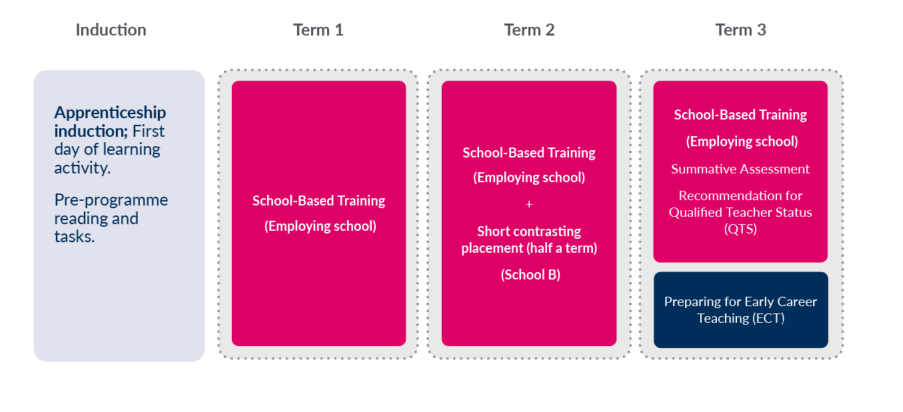
What Will I Learn During My Initial Teacher Training?
Our curriculum is designed to build your skills and confidence progressively, blending theory with hands-on classroom experience.
You’ll complete two school placements across the year, supported by a personal tutor and subject specialists throughout your journey.
Your training will include:
- 12 Core Training sessions – these are delivered online and are carefully designed to teach the core body of knowledge and skills that define great teaching.
- 4 Intensive Training and Practice (ITAP) Weeks – see expert teaching in action and apply new strategies in your own lessons.
Core learning areas:
- Behaviour Support & Classroom Management
- Curriculum Delivery
- Teacher Development
By the end of your programme, you’ll be ready to teach up to 80% of a full timetable and demonstrate the skills required for Qualified Teacher Status (QTS).
Upon completion of your practical training, you will...
- Present your evidence portfolio and demonstrate your readiness to be awarded Qualified Teacher Status (QTS).
- (For Apprenticeship route only) complete your Apprenticeship Assessment.
Frequently Asked Questions
ITT FAQs
Yes. Any offer of a place is conditional upon satisfactory Occupational Health clearance, a DBS check, and completion of mandatory safeguarding training.
To support your teacher training journey, Best Practice Network assesses all Fee-Funded ITT applicants to identify any occupational health requirements and reasonable adjustments that may be needed to successfully complete the programme.
Best Practice Network will fund Occupational Health assessment Categories A and B. Where a Category C Management Referral Assessment is required, applicants will be responsible for meeting the cost of the assessment. Applicants should therefore be aware of this potential requirement before accepting a place on the programme.
In addition:
It must be understood that any reasonable adjustments agreed and accepted by the ITT provider are for the purpose of undertaking initial teacher training. Best Practice Network cannot guarantee that the same adjustments would be deemed reasonable or available in future employment. Where there is concern that proposed adjustments may not be considered reasonable within future teaching employment, applicants will be informed before training commences.
To be eligible for our Initial Teacher Training programme, you must have the right to study and work in the UK. If you require a visa to study or work in the UK, unfortunately, we cannot sponsor visas.
Qualifications achieved outside of the United Kingdom (including Ireland) will need to be verified via UK ENIC through a comparability statement. If you need an ENIC for your bachelor’s degree, you will need to have this before you apply. If you need help, our expert team can assist you with this.
You'll need to apply for an equivalency GCSE.
We accept equivalency tests from:
- A Star Equivalency www.astarequivalency.co.uk
- Equivalency Testing www.equivalencytesting.co.uk
- Maths Made Easy www.mathsmadeeasy.co.uk
(This will be at your own cost).
If you also have non-UK GCSE equivalent examinations, send all of your certificates together.
(This will be at your own cost).
No. Although these are Level 2 qualifications, as are GCSEs, they do not cover the same breadth of knowledge so cannot be accepted as equivalent to a GCSE.
During the programme, you will complete placements at two local schools: a host school where you'll train for 30 weeks, and a contrasting placement school for half of Term 2, to ensure you have experience teaching across the full age range in your chosen specialism. Our team will help you source and contact placement schools, so you're supported every step of the way.
No – you only need Qualified Teacher Status to be employed as a qualified teacher in England, which you achieve on successful completion of our course. A PGCE is an additional academic qualification awarded by a university, which some providers offer alongside QTS.
Fee-funded Initial Teacher Training is an unsalaried training route perfect for those not currently employed in a school; it is funded through student loans and, where eligible, bursaries and scholarships. The Postgraduate Teacher Apprenticeship route is a salaried route to Qualified Teacher Status for those currently employed in a school; it is funded through your school's Growth and Skills Levy fund.
Both routes award Qualified Teacher Status, which is needed to teach in schools across England.
Although not essential, prior school experience will strengthen your application and provide you with an invaluable insight into what teaching is really like and the role and responsibilities of a classroom teacher.
A good starting point is to reach out to schools in your area to find out if they have capacity to take on a student teacher. Be flexible. Schools might not be able to offer you exactly what you request. Volunteering is a great option if your schedule permits.
Schools may require a DBS check as a matter of policy, and you will need this as a student teacher. Our team will support you with school placements and the application process.
We don't currently offer a direct Undergraduate QTS route or the Teacher Degree Apprenticeship. At this time, we are only able to offer postgraduate teacher training courses.
The best route into teaching depends on your experience, qualifications, and personal circumstances. For graduates looking to start a teaching career, we offer two pathways to QTS - Fee-Funded Initial Teacher Training (ITT) and the Postgraduate Teacher Apprenticeship (PGTA).
A fee-funded ITT programme is ideal for those who want structured teacher training with extensive classroom experience, leading to Qualified Teacher Status (QTS). Alternatively, a Postgraduate Teacher Apprenticeship allows you to earn a salary while you train, making it a great option for those already working in a school or looking to learn on the job.
Both routes provide the skills, knowledge, and practical experience needed to become an effective teacher. The best option will depend on whether you prefer a traditional training route or an apprenticeship that combines employment with teacher training.
At Best Practice Network, we're looking for people who are committed to becoming outstanding teachers and making a positive difference to the lives of children and young people. Successful candidates are passionate about education, enthusiastic about learning, and dedicated to helping every child achieve their potential.
The skills and qualities needed to become a teacher go beyond academic qualifications. We look for individuals with excellent communication and organisational skills, strong interpersonal abilities, resilience, and a proactive approach to professional development. The ability to reflect on practice, adapt to challenges, and build positive relationships with pupils, colleagues, and families is essential.
We also value determination, energy, and a commitment to maintaining high standards in the classroom. Strong English and mathematics skills, alongside excellent subject knowledge, are key foundations for success in teacher training and throughout your teaching career.
Whether you're considering Initial Teacher Training (ITT) or a Postgraduate Teacher Apprenticeship, the most successful trainees are those who are motivated to learn, embrace feedback, and are passionate about delivering the best possible outcomes for children.
At Best Practice Network, we are committed to providing high-quality support throughout your teacher training journey. Whatever programme you choose, you'll benefit from a comprehensive support network designed to help you develop into a confident and successful teacher.
As a student teacher, you will receive guidance from experienced mentors, personal tutors and wellbeing teams who will support your progress both in the classroom and through your training programme. On top of this, you'll have access to a nationwide community of student teachers across the country.
Yes. At Best Practice Network, our Initial Teacher Training (ITT) programmes offer a range of specialist pathways, allowing you to tailor your teacher training to your interests, strengths, and career aspirations while working towards Qualified Teacher Status (QTS).
Primary Teacher Training
If you're interested in primary teacher training, you can choose from the following pathways:
3-7 (Early Years and Key Stage 1)
This route includes an Early Years specialism, with placements taking place across Early Years and Key Stage 1 settings. It is ideal for those who are passionate about supporting children's development in their earliest years of education.
5-11 (Key Stage 1 and Key Stage 2)
This pathway focuses on teaching across the full primary curriculum, with placements in both Key Stage 1 and Key Stage 2 classrooms. It is ideal for trainees who want experience across the broader primary age range.
We also offer opportunities to gain experience in Special Educational Needs and Disabilities (SEND) provision. Whichever primary route you choose, you will gain QTS, qualifying you to teach across the entire primary phase.
SEND Teacher Training
Our specialist SEND teacher training programme is designed for those who are passionate about supporting children and young people with special educational needs and disabilities. Developed in partnership with The Gallery Trust, the programme combines expert SEND training with hands-on classroom experience.
Unlike traditional teacher training programmes, the SEND pathway is designed around children's developmental stages, recognising that pupils with SEND often learn and develop differently.
You can choose from the following curriculum pathways:
- 3-7: Supporting children working at EYFS and Key Stage 1 levels.
- 5-11: Supporting learners across Key Stage 1 and Key Stage 2.
- 7-14: Supporting learners across Key Stage 2 and Key Stage 3.
Secondary Teacher Training
If you're interested in secondary teacher training, you will choose a subject specialism and develop expertise in your chosen area. Subject specialisms include:
- English
- Mathematics
- Biology
- Chemistry
- Computing
As part of your training, you will teach pupils in at least two schools before being awarded QTS, gaining valuable experience in different educational settings. All secondary pathways lead to QTS, qualifying you to teach across the secondary phase regardless of your chosen subject specialism.
Yes. If you already hold Early Years Teacher Status (EYTS), you may be eligible to train for Qualified Teacher Status (QTS) through one of our teacher training routes.
We would typically recommend considering the Postgraduate Teacher Apprenticeship if you are currently employed in a setting that includes Key Stage 1 provision, as this can allow you to gain QTS while continuing to work and develop your teaching practice.
Gaining QTS can broaden your career opportunities, enabling you to teach in primary schools and expanding your experience beyond the Early Years Foundation Stage. Our team can help you explore the most suitable route based on your qualifications, experience, and current employment setting.
Yes. Strong communication skills are essential for a successful teaching career, so your ability to speak, read and write in English will be assessed throughout the application and selection process.
This includes reviewing your written application, observing your communication during interviews, and ensuring you can communicate effectively with pupils, colleagues and families. As a trainee teacher, you'll need a high standard of written and spoken English to support learning, maintain professional records, and deliver high-quality teaching.
Demonstrating clear and confident communication is an important part of meeting the requirements for Initial Teacher Training (ITT) and progressing towards Qualified Teacher Status (QTS).
If you hold a Master's degree but do not have a Bachelor's degree, you may still be considered for teacher training. However, you will need to demonstrate that your academic study is equivalent to degree-level learning, including the breadth, depth, and duration typically associated with an undergraduate qualification.
As a guide, your academic experience would normally need to reflect at least three years of higher education study and provide evidence of sustained academic achievement.
Each application is assessed individually, and our admissions team will review your qualifications to determine whether they meet the entry requirements for Initial Teacher Training (ITT) and Qualified Teacher Status (QTS).
No. You are not expected to be teaching independently for four days a week from the start of the programme. Your teaching responsibilities will gradually increase as your confidence, knowledge, and classroom experience develop.
During the early stages of your Initial Teacher Training (ITT) or Postgraduate Teacher Apprenticeship, you may begin by observing lessons, working with small groups, team teaching, and supporting pupils in a role similar to a Teaching Assistant. As the programme progresses, you will take on increasing responsibility for planning, teaching and assessing whole-class lessons.
This gradual approach ensures you receive the support and practical experience needed to develop into a confident and effective teacher while working towards Qualified Teacher Status (QTS).
No. If you already hold Qualified Teacher Status (QTS), for example through a Secondary PGCE or Secondary Initial Teacher Training route, you do not need to gain QTS again in a different phase.
QTS is a professional teaching qualification that allows you to teach across age phases. If you are interested in moving from secondary education into Early Years or primary teaching, you can apply for suitable teaching roles and develop your experience through professional development opportunities rather than undertaking another QTS programme.
If your goal is to specialise in Early Years education, we recommend exploring relevant training and development opportunities that will help you build expertise in the Early Years Foundation Stage (EYFS) and early childhood education.
Additional Thrive-informed Training
As part of your teacher training journey with Best Practice Network, you’ll also have the opportunity to access our Thrive-informed Educator Training, a short, practical programme designed to strengthen your understanding of pupil wellbeing and behaviour.
This optional training helps you build confidence in the classroom by exploring how trauma, relationships and emotional wellbeing influence learning. You’ll develop practical strategies for creating safe, supportive environments where all pupils can thrive.
_1000(1).png)
Primary Teacher Training Comparison Table
Use the table below to compare the key features of our Fee-Funded Initial Teacher Training and Teacher Apprenticeship programmes at a glance.
📱 On mobile? Swipe sideways to see the full table →
Hear what our student teachers have to say...
Why choose Best Practice Network for your teacher training?
- Ofsted outstanding: provider of the DfE’s full teacher progression pathway, supporting student teachers from entry into teaching through to executive leadership.
- 20+ Years experience: Delivering teacher training and professional qualifications for teachers, school leaders, support staff and early years professionals.
- Subject & phase specific groups: As a leading national provider our enrolment enables student teachers to train alongside peers specific to their phase, subject and specialism.
- Local placement: Our network of 500+ schools provides our student teachers local access to in-school placements.
- Supporting wellbeing: Our pathway is QTS-only helping support student teacher capacity and wellbeing on their journey into teaching.
- Award-winning: Best Practice Network has been named Education Apprenticeship Training Provider of the Year for the past two years.
- 100% of our 2023/24 graduate teachers have secured employment for September
.png)
Meet the team!
