

⚠️Limited funding available⚠️
The Department for Education has agreed to fund 1,000 places on the EY SENCO programme for early years practitioners and childminders in England.
Places are limited and demand is expected to be high — we strongly recommend applying as soon as possible for the best chance of securing your place.
Congratulations! You appear to be eligible to apply. Please click the link below to begin your application
Unfortunately, you do not appear to be eligible.
Please contact our team to discuss your options.
To apply, you must hold a full and relevant Level 3 Early Years qualification.
If you are a childminder you must hold a relevant Level 2 Qualification and have completed at least one Level 3 training module
You can check your qualification status at https://check-an-early-years-qualification.service.gov.uk/
Question 1: Do you have a full and relevant Level 3 Early Years qualification?
To apply, you must work in one of the following types of setting:
An Ofsted-registered private, voluntary and independent nursery, such as a private day nursery, pre-school or playgroup
An Ofsted registered childminder
A childminder registered with the Childminding Agency
The following are examples of ineligible settings:
❌School-based nurseries
❌Maintained nurseries run by Local Authorities/Councils
Question 2: Do you work in one of these types of setting?
There are just 1,000 fully funded places available for the EY SENCO Level 3, and demand is expected to be high.
Please only apply if you are committed to completing the full 6-month programme — accepting a place and then dropping out may mean someone else misses out on this opportunity.
Question 3: Are you committed to completing Early Years SENCO
Become a partner
Best Practice Network collaborates with a wide range of educational organisations including schools, multi-academy trusts (MATs), teaching school hubs (TSHs), dioceses, and other school groups . Together, we deliver high-impact professional development across their networks.
We offer three distinct partnership models, designed to suit the needs and goals of different types of education providers:
- Accredited Delivery Partners - Work closely with us to host, facilitate, and promote high-quality training programmes that are contextualised to the needs of local schools and learners, driving engagement and impact across their networks
Learn more - Trust Partners – Work with us to strengthen workforce development, support retention and progression, and ensure access to a broad suite of professional development opportunities while maintaining clear oversight of learner engagement and progress
Learn more - Early Years Partners - Work with us as employer partners to grow and retain skilled early years practitioners, strengthen career pathways across settings, and provide access to high-quality apprenticeships, with regular updates on learner progress and development
Learn more
A league of learning
Just a few of the standout players in our growing partnership line-up.
.png)

 Awards Level 3
EY SENCO
 Online learning

Course duration
6 Months
Postgraduate Teacher
Apprenticeship with QTS
Qualify as a Primary, Secondary or SEND teacher
The Teacher Apprenticeship is designed for graduates of any subject and awards Qualified Teacher Status (QTS).
Apply by May 18 for a June start.

Course duration
12 Months + End Point Assessment

Qualified Teacher Status (QTS)

In-school placement
4 days a week

Teacher Training
1 day a week

Personal Tutor visits & observation

Full-time (minimum of 30 hours a week)
What is the Postgraduate Teacher Apprenticeship?
The Teacher Apprenticeship is a school-based training programme. This pathway is completely free for the learner, as it is funded through the Apprenticeship Levy.
During the apprenticeship, you will be employed by a school and receive a salary on the Unqualified Teacher Pay scale (depending on location).
Successful completion of this programme will award Qualified Teacher Status (QTS) and a Level 6 Teacher Apprenticeship Qualification, which will qualify you to teach in all schools in England.
- Learn in the classroom from Day 1
- Become a qualified teacher in just 15 months
- Earn a yearly salary of at least £21,731 while you learn
- Training costs are covered by the Apprenticeship Levy
- School-Centred Initial Teacher Training (SCITT) (Learn more)
-
Once qualified, start on a minimum salary of £31-£38k (dependent on location)
Start your training in June!
Most aspiring teachers wait until September to start their training, but you don’t have to! With Best Practice Network, you can begin your journey to Qualified Teacher Status (QTS) this June, giving you a head start before the busy back-to-school period.
Starting in June gives you the opportunity to:
- Ease into teaching: Settle into school life during the quieter summer term, giving you more time to familiarise yourself with your placement school, colleagues and pupils
- Build confidence early: Develop your teaching skills and gain confidence before the new academic year begins
- Fast-track your career: Starting earlier means you’ll qualify before the majority of student teachers, so you will have an advantage when searching for a full-time teaching role
- Stand out to employers: Demonstrate your enthusiasm, commitment and initiative by beginning your training early, making you highly attractive to prospective schools
.gif)
Who should apply for the Postgraduate Teacher Apprenticeship?
The Postgraduate Teacher Apprenticeship is an ideal training pathway for individuals who hold a degree in any subject and are looking to become a qualified teacher.
This programme is perfect for:
- Support staff and teaching assistants looking to progress into teaching
- Unqualified teachers looking to gain Qualified Teacher Status
- Graduates or career changers looking for their first teaching role
If you're not already working in a school, you'll need to secure a school-based placement before starting your apprenticeship. If you need support, our expert team is here to help you find the perfect school placement before your training begins.
To apply for this programme, you must meet the following requirements:
- Hold a bachelor’s degree (or equivalent) in any subject with a minimum 2:2 classification*
- Have achieved at least grade 4 (C) in GCSE English and mathematics (or equivalent)
- If applying for Primary specialism, have also achieved grade 4 (C) in a science subject
- Must have held residency in the UK for the last three years*
*For more information on eligibility criteria, please visit our eligibility section.
.png)
Programme Overview
Primary programme overview
SEND programme overview
Secondary programme overview
Interested in teaching secondary? Find the right subject for you⬇️
How is the Postgraduate Teacher Apprenticeship delivered?
Apprentice teachers can start their training in either June or September 2025. Over 12 months, they will complete their practical training while continuing to work in their current school. Throughout the programme, 20% of their time will be dedicated to off-the-job training delivered by Best Practice Network.
Following this, they will undertake a three-month End-Point Assessment (EPA). Upon successful completion of the EPA, they will be awarded the Level 6 Teacher Apprenticeship qualification.
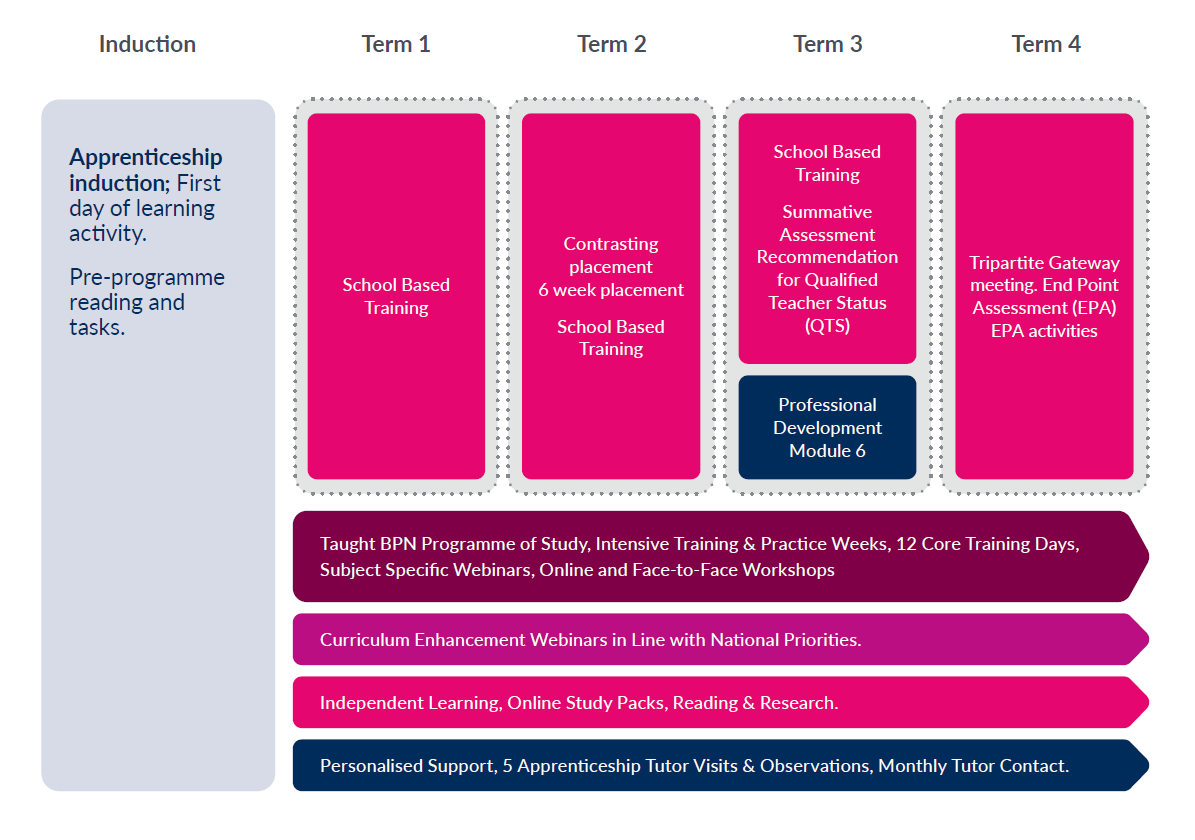
- Induction: you will have your first day of learning and ITT Induction before the start of your training to help you prepare for the programme
- Term 1: you will be in your host school this term. Training in school four days a week and attending online or in-person training one day a week
- Term 2: you will spend 6 weeks in a contrasting school placement. This placement will be organised by our placement co-ordinators
- Term 3: you will return to your host school to prepare for the recommendation of QTS
- Term 4: End Point Assessment for Level 6 Teacher Apprenticeship Qualification
Why choose Best Practice Network for your teacher training?
- Ofsted outstanding: we are a top-rated provider of the Department for Education’s teacher progression pathway, guiding you from your Initial Teacher Training through to executive headteacher roles
- 20+ years experience: delivering teacher training and professional qualifications for teachers, school leaders, support staff and early years professionals
- Subject and phase specific groups: as part of a leading national provider, you'll train alongside peers across the country, specific to your chosen specialism
- Local placement: benefit from our network of 500+ partner schools, giving you access to local, high-quality in-school placements
- Supporting wellbeing: our QTS-only pathway is designed to support your capacity and well-being as you transition into your teaching career
- Award-winning provider: Best Practice Network has been recognised as Education Apprenticeship Training Provider of the Year for two consecutive years
- 100% of our 2023/24 graduate teachers secured employment for September
 12.png)
.png)
Don't just take our word for it! Check out what our student teachers think of the programme...
Meet the team!
.png)
.png)
.png)
.png)
.png)
.png)
.png)
Apply for Primary Specialisms
You must already be employed in a school to apply for the primary specialisms. If you are not employed by a school, please see our Initial Teacher Training page.
Choose from one of two age ranges – both are full-time.
| Specialism | Age Range | Start Dates |
| Primary | 3-7 years | June or September |
| Primary | 5-11 years |
June or September |
Apply now for the next intake!
Congratulations! You appear to be eligible to apply. Please click the link below to begin your application
Unfortunately, you do not appear to be eligible.
Please contact our team to discuss your options.
To apply, you must have lived in the UK for the last 3 consecutive years.
Question 1: Have you lived in the UK for at least the last 3 consecutive years?
To apply, you must have have the right to work and study in the UK.
Question 2: Do you have the right to work and study in the UK?
To join this programme, you must hold a bachelor’s degree.
Question 3: Do you have a bachelor's degree?
To apply for the Teacher Apprenticeship, you must be working in a school as a teaching assistant, cover supervisor or other support role. Please confirm you are working in a school.
Question 4: Are you currently employed in a school?
Apply for SEND Teacher Training
Apply for SEND Specialisms
You must already be employed in a school to apply for the primary specialisms. If you are not employed by a school, please see our Initial Teacher Training page.
Choose from one of two age ranges – both are full-time.
| Specialism | Curriculum pathway | Start Dates |
| SEND | 3-7 years | June or September |
| SEND | 5-11 years |
June or September |
Please apply now for the next intake!
Congratulations! You appear to be eligible to apply. Please click the link below to begin your application
Apply for 5-11 SEND Specialism
Unfortunately, you do not appear to be eligible.
Please contact our team to discuss your options.
To apply, you must have lived in the UK for the last 3 consecutive years.
Question 1: Have you lived in the UK for at least the last 3 consecutive years?
To apply, you must have have the right to work and study in the UK.
Question 2: Do you have the right to work and study in the UK?
To join this programme, you must hold a bachelor’s degree.
Question 3: Do you have a bachelor's degree?
To apply for the Teacher Apprenticeship, you must be working in a school as a teaching assistant, cover supervisor or other support role. Please confirm you are working in a school.
Question 4: Are you currently employed in a school?
Apply for Secondary Specialisms
Our programme prepares you for a lifelong career as a secondary teacher and specialist within your chosen subject, teaching up to GCSE level. Additionally, we offer post-16 enhancement to provide you with the skills to teach your subject at A Level, expanding your expertise and teaching opportunities.
| Specialism | Age Range | Start Dates |
| Biology | Secondary | June or September |
| Chemistry | Secondary |
June or September |
| Computing | Secondary | June or September |
| English | Secondary |
June or September |
| French | Secondary | June or September |
| Geography | Secondary |
June or September |
| Maths | Secondary | June or September |
| Spanish | Secondary |
June or September |
Apply now for the next intake!
Congratulations! You appear to be eligible to apply. Please click the link below to begin your application
Apply for Biology Apply for Chemistry Apply for Computing Apply for English
Apply for French Apply for Geography Apply for Maths Apply for Spanish
Unfortunately, you do not appear to be eligible.
Please contact our team to discuss your options.
To apply, you must have lived in the UK for the last 3 consecutive years.
Question 1: Have you lived in the UK for at least the last 3 consecutive years?
To apply, you must have have the right to work and study in the UK.
Question 2: Do you have the right to work and study in the UK?
To join this programme, you must hold a bachelor’s degree.
Question 3: Do you have a bachelor's degree?
To apply for the Teacher Apprenticeship, you must be working in a school as a teaching assistant, cover supervisor or other support role. Please confirm you are working in a school.
Question 4: Are you currently employed in a school?
Subject Knowledge Enhancement SKE
If you are considering a secondary specialism, you might need to do a subject knowledge enhancement (SKE) course before you start your teacher training to top up your subject knowledge. This could be because you have (one or more of the following):
- A degree in your subject but have not used your degree knowledge for more than 5 years
- a different but related degree to the subject you want to teach
- an A level but not a degree in the subject you want to teach
- an unrelated degree but relevant professional experience
- studied for a languages degree, but need to improve knowledge either in a main language, second language or both to an acceptable level for teaching in schools
SKE courses are fully funded by the DfE, and eligible candidates receive an SKE bursary. As part of your interview, we will review your subject knowledge and if we identify you need to enhance your knowledge prior to starting your training. This will form part of your condition of entry to the programme.
You can find out more about SKE courses in this SKE Trainee Brochure.
We interviewed one of our Apprentice Teachers, Molly, to find out what a typical week looks like for her. You can view her diary below:
.png)
.png)
.png)
.png)
.png)
.png)
.png)
Please note that this schedule is just an example and your schedule will depend on your arrangements with your employer. But this should give you an idea of what a Teacher Apprenticeship involves.
- Hold a bachelor’s degree (or equivalent) in any subject with a minimum 2:2 classification*
- Have achieved at least grade 4 (C) in GCSE English and mathematics (or equivalent)**
- If applying for Primary specialism, have also achieved grade 4 (C) in a science subject
- Must have held residency in the UK for the last three years***
*If your degree is an ordinary, or 3rd class, your application will be considered on a case-by-case basis by our team.
**Please note applicants who have achieved or are taking an equivalence test, or hold other evidence of maths and English attainment that intend to undertake the Post Graduate Teaching Apprenticeship (PGTA) will need functional skills qualifications or equivalent qualifications at level 2 in mathematics and English to meet the apprenticeship gateway entry criteria.
***If you are not a British citizen, you will need to be able to evidence that your visa is valid for the entire duration of the programme.
There are no fees for student teacher apprentices. The fees are paid by the school through their Apprenticeship Levy or through government co-investment if the school is not an Apprenticeship Levy payer.
Student finance and maintenance loans are not available. You are paid a salary on the unqualified teacher scale (UNQ1). Certain rules apply.
ITT FAQs
Yes. Any offer of a place is conditional upon satisfactory Occupational Health clearance, a DBS check, and completion of mandatory safeguarding training.
To support your teacher training journey, Best Practice Network assesses all Fee-Funded ITT applicants to identify any occupational health requirements and reasonable adjustments that may be needed to successfully complete the programme.
Best Practice Network will fund Occupational Health assessment Categories A and B. Where a Category C Management Referral Assessment is required, applicants will be responsible for meeting the cost of the assessment. Applicants should therefore be aware of this potential requirement before accepting a place on the programme.
In addition:
It must be understood that any reasonable adjustments agreed and accepted by the ITT provider are for the purpose of undertaking initial teacher training. Best Practice Network cannot guarantee that the same adjustments would be deemed reasonable or available in future employment. Where there is concern that proposed adjustments may not be considered reasonable within future teaching employment, applicants will be informed before training commences.
To be eligible for our Initial Teacher Training programme, you must have the right to study and work in the UK. If you require a visa to study or work in the UK, unfortunately, we cannot sponsor visas.
Qualifications achieved outside of the United Kingdom (including Ireland) will need to be verified via UK ENIC through a comparability statement. If you need an ENIC for your bachelor’s degree, you will need to have this before you apply. If you need help, our expert team can assist you with this.
You'll need to apply for an equivalency GCSE.
We accept equivalency tests from:
- A Star Equivalency www.astarequivalency.co.uk
- Equivalency Testing www.equivalencytesting.co.uk
- Maths Made Easy www.mathsmadeeasy.co.uk
(This will be at your own cost).
If you also have non-UK GCSE equivalent examinations, send all of your certificates together.
(This will be at your own cost).
No. Although these are Level 2 qualifications, as are GCSEs, they do not cover the same breadth of knowledge so cannot be accepted as equivalent to a GCSE.
During the programme, you will complete placements at two local schools: a host school where you'll train for 30 weeks, and a contrasting placement school for half of Term 2, to ensure you have experience teaching across the full age range in your chosen specialism. Our team will help you source and contact placement schools, so you're supported every step of the way.
No – you only need Qualified Teacher Status to be employed as a qualified teacher in England, which you achieve on successful completion of our course. A PGCE is an additional academic qualification awarded by a university, which some providers offer alongside QTS.
Fee-funded Initial Teacher Training is an unsalaried training route perfect for those not currently employed in a school; it is funded through student loans and, where eligible, bursaries and scholarships. The Postgraduate Teacher Apprenticeship route is a salaried route to Qualified Teacher Status for those currently employed in a school; it is funded through your school's Growth and Skills Levy fund.
Both routes award Qualified Teacher Status, which is needed to teach in schools across England.
Although not essential, prior school experience will strengthen your application and provide you with an invaluable insight into what teaching is really like and the role and responsibilities of a classroom teacher.
A good starting point is to reach out to schools in your area to find out if they have capacity to take on a student teacher. Be flexible. Schools might not be able to offer you exactly what you request. Volunteering is a great option if your schedule permits.
Schools may require a DBS check as a matter of policy, and you will need this as a student teacher. Our team will support you with school placements and the application process.
We don't currently offer a direct Undergraduate QTS route or the Teacher Degree Apprenticeship. At this time, we are only able to offer postgraduate teacher training courses.
The best route into teaching depends on your experience, qualifications, and personal circumstances. For graduates looking to start a teaching career, we offer two pathways to QTS - Fee-Funded Initial Teacher Training (ITT) and the Postgraduate Teacher Apprenticeship (PGTA).
A fee-funded ITT programme is ideal for those who want structured teacher training with extensive classroom experience, leading to Qualified Teacher Status (QTS). Alternatively, a Postgraduate Teacher Apprenticeship allows you to earn a salary while you train, making it a great option for those already working in a school or looking to learn on the job.
Both routes provide the skills, knowledge, and practical experience needed to become an effective teacher. The best option will depend on whether you prefer a traditional training route or an apprenticeship that combines employment with teacher training.
At Best Practice Network, we're looking for people who are committed to becoming outstanding teachers and making a positive difference to the lives of children and young people. Successful candidates are passionate about education, enthusiastic about learning, and dedicated to helping every child achieve their potential.
The skills and qualities needed to become a teacher go beyond academic qualifications. We look for individuals with excellent communication and organisational skills, strong interpersonal abilities, resilience, and a proactive approach to professional development. The ability to reflect on practice, adapt to challenges, and build positive relationships with pupils, colleagues, and families is essential.
We also value determination, energy, and a commitment to maintaining high standards in the classroom. Strong English and mathematics skills, alongside excellent subject knowledge, are key foundations for success in teacher training and throughout your teaching career.
Whether you're considering Initial Teacher Training (ITT) or a Postgraduate Teacher Apprenticeship, the most successful trainees are those who are motivated to learn, embrace feedback, and are passionate about delivering the best possible outcomes for children.
At Best Practice Network, we are committed to providing high-quality support throughout your teacher training journey. Whatever programme you choose, you'll benefit from a comprehensive support network designed to help you develop into a confident and successful teacher.
As a student teacher, you will receive guidance from experienced mentors, personal tutors and wellbeing teams who will support your progress both in the classroom and through your training programme. On top of this, you'll have access to a nationwide community of student teachers across the country.
Yes. At Best Practice Network, our Initial Teacher Training (ITT) programmes offer a range of specialist pathways, allowing you to tailor your teacher training to your interests, strengths, and career aspirations while working towards Qualified Teacher Status (QTS).
Primary Teacher Training
If you're interested in primary teacher training, you can choose from the following pathways:
3-7 (Early Years and Key Stage 1)
This route includes an Early Years specialism, with placements taking place across Early Years and Key Stage 1 settings. It is ideal for those who are passionate about supporting children's development in their earliest years of education.
5-11 (Key Stage 1 and Key Stage 2)
This pathway focuses on teaching across the full primary curriculum, with placements in both Key Stage 1 and Key Stage 2 classrooms. It is ideal for trainees who want experience across the broader primary age range.
We also offer opportunities to gain experience in Special Educational Needs and Disabilities (SEND) provision. Whichever primary route you choose, you will gain QTS, qualifying you to teach across the entire primary phase.
SEND Teacher Training
Our specialist SEND teacher training programme is designed for those who are passionate about supporting children and young people with special educational needs and disabilities. Developed in partnership with The Gallery Trust, the programme combines expert SEND training with hands-on classroom experience.
Unlike traditional teacher training programmes, the SEND pathway is designed around children's developmental stages, recognising that pupils with SEND often learn and develop differently.
You can choose from the following curriculum pathways:
- 3-7: Supporting children working at EYFS and Key Stage 1 levels.
- 5-11: Supporting learners across Key Stage 1 and Key Stage 2.
- 7-14: Supporting learners across Key Stage 2 and Key Stage 3.
Secondary Teacher Training
If you're interested in secondary teacher training, you will choose a subject specialism and develop expertise in your chosen area. Subject specialisms include:
- English
- Mathematics
- Biology
- Chemistry
- Computing
As part of your training, you will teach pupils in at least two schools before being awarded QTS, gaining valuable experience in different educational settings. All secondary pathways lead to QTS, qualifying you to teach across the secondary phase regardless of your chosen subject specialism.
Yes. If you already hold Early Years Teacher Status (EYTS), you may be eligible to train for Qualified Teacher Status (QTS) through one of our teacher training routes.
We would typically recommend considering the Postgraduate Teacher Apprenticeship if you are currently employed in a setting that includes Key Stage 1 provision, as this can allow you to gain QTS while continuing to work and develop your teaching practice.
Gaining QTS can broaden your career opportunities, enabling you to teach in primary schools and expanding your experience beyond the Early Years Foundation Stage. Our team can help you explore the most suitable route based on your qualifications, experience, and current employment setting.
Yes. Strong communication skills are essential for a successful teaching career, so your ability to speak, read and write in English will be assessed throughout the application and selection process.
This includes reviewing your written application, observing your communication during interviews, and ensuring you can communicate effectively with pupils, colleagues and families. As a trainee teacher, you'll need a high standard of written and spoken English to support learning, maintain professional records, and deliver high-quality teaching.
Demonstrating clear and confident communication is an important part of meeting the requirements for Initial Teacher Training (ITT) and progressing towards Qualified Teacher Status (QTS).
If you hold a Master's degree but do not have a Bachelor's degree, you may still be considered for teacher training. However, you will need to demonstrate that your academic study is equivalent to degree-level learning, including the breadth, depth, and duration typically associated with an undergraduate qualification.
As a guide, your academic experience would normally need to reflect at least three years of higher education study and provide evidence of sustained academic achievement.
Each application is assessed individually, and our admissions team will review your qualifications to determine whether they meet the entry requirements for Initial Teacher Training (ITT) and Qualified Teacher Status (QTS).
No. You are not expected to be teaching independently for four days a week from the start of the programme. Your teaching responsibilities will gradually increase as your confidence, knowledge, and classroom experience develop.
During the early stages of your Initial Teacher Training (ITT) or Postgraduate Teacher Apprenticeship, you may begin by observing lessons, working with small groups, team teaching, and supporting pupils in a role similar to a Teaching Assistant. As the programme progresses, you will take on increasing responsibility for planning, teaching and assessing whole-class lessons.
This gradual approach ensures you receive the support and practical experience needed to develop into a confident and effective teacher while working towards Qualified Teacher Status (QTS).
No. If you already hold Qualified Teacher Status (QTS), for example through a Secondary PGCE or Secondary Initial Teacher Training route, you do not need to gain QTS again in a different phase.
QTS is a professional teaching qualification that allows you to teach across age phases. If you are interested in moving from secondary education into Early Years or primary teaching, you can apply for suitable teaching roles and develop your experience through professional development opportunities rather than undertaking another QTS programme.
If your goal is to specialise in Early Years education, we recommend exploring relevant training and development opportunities that will help you build expertise in the Early Years Foundation Stage (EYFS) and early childhood education.
Join our interest list
If you are already working within a school and interested in starting a Teacher Apprenticeship, join our interest list and receive the latest updates directly to your inbox
Related Courses and Content