

Shifting SEND support toward mainstream school inclusion
In February 2026, the UK government published the schools white paper, outlining reforms to England's SEND system, with greater emphasis on supporting children and young people with SEND within mainstream settings.
For school leaders, this means building the capacity, confidence and expertise of the wider workforce. Now is the time to strengthen your a whole school SEND team to create an inclusive environment where every pupil can participate, belong and achieve.

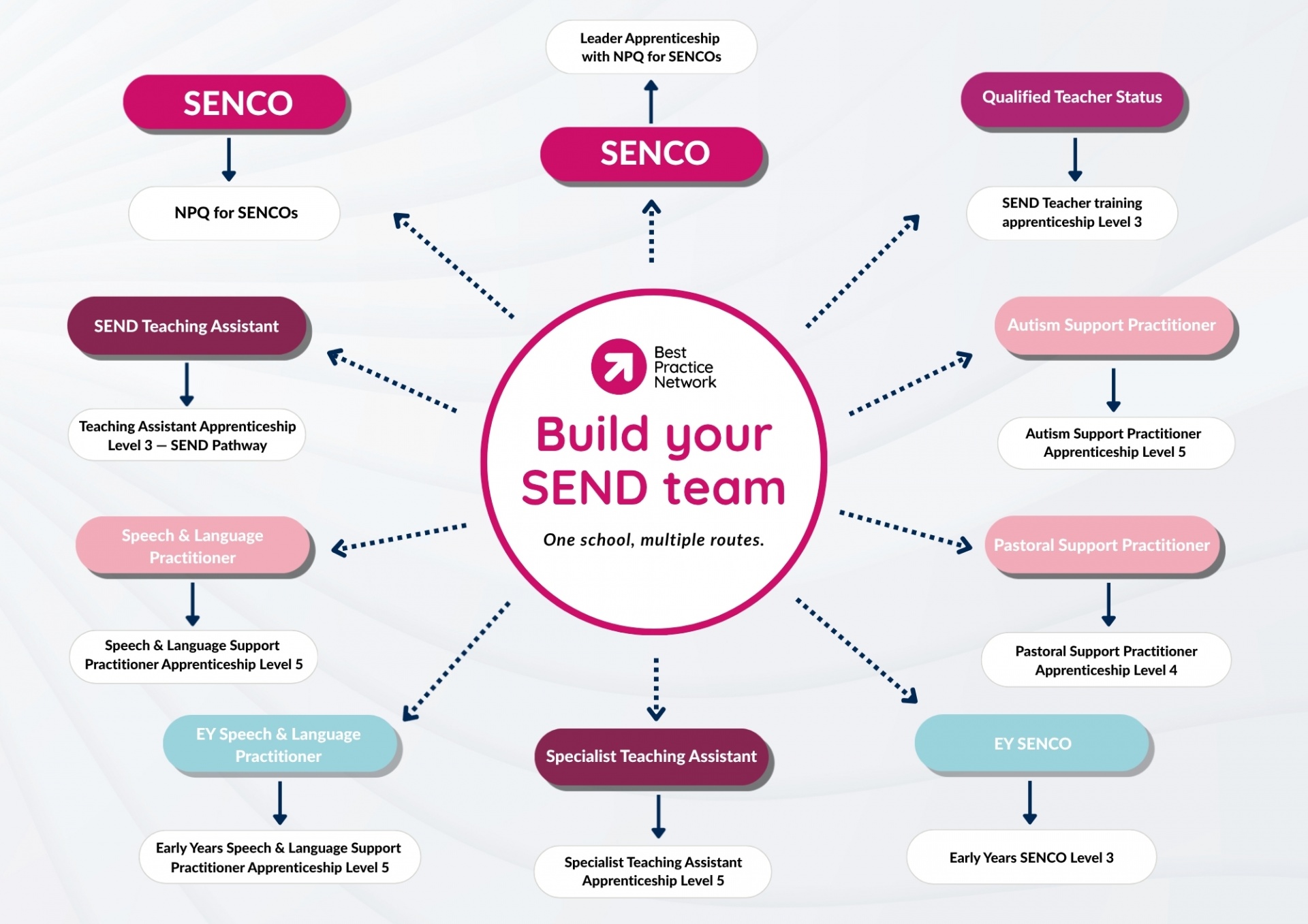
Build your SEND team
There is no single SEND role, and no single solution for SEND training. Your SENCO may lead SEND provision, but creating genuinely inclusive practice requires the expertise and commitment of a wider team. By developing the knowledge and skills of teachers, teaching assistants, specialist practitioners and leaders, you can build a confident SEND team that delivers consistent support, strengthens outcomes for pupils with SEND and helps every child thrive in your setting.

.png)
.png)
.png)
.png)
.png)
Explore programmes for your school or setting
We offer SEND programmes tailored to the needs of both schools and early years settings. Choose your setting below to discover the training and development opportunities that are the best fit for your team.
Not sure which pathway is right for your setting?
Sign up for exclusive SEND Suite updates
Enter your details to receive information about the SEND Suite, including programme guidance, brochures, pathway recommendations, application updates and key deadlines.
Whether you're a SENCO, teacher, teaching assistant, practitioner or school leader, we'll help you explore the most suitable SEND development opportunities for your setting.
NOTE: This form is not an application. Registering your interest allows us to send you further information about SEND programmes, apprenticeships and qualifications designed to help schools build whole-school SEND expertise and improve outcomes for pupils with SEND

How Ofsted see SEND inclusion
Having a dedicated SEND team can strengthen a school's position during an Ofsted inspection as it demonstrates that inclusion is embedded across the organisation rather than being led solely by the SENCO. The framework emphasises collaboration between teachers, support staff, leaders and families, with educational leaders playing a crucial role in driving inclusive practice and monitoring outcomes.

Frequently asked questions
SEND stands for Special Educational Needs and Disabilities. In schools, it refers to additional support provided to pupils who have a learning difficulty, disability or developmental need that requires provision beyond what is typically available in the classroom. The SEND system helps schools identify needs early, provide targeted support and improve outcomes for every learner.
The SEND Code of Practice promotes inclusion by setting out how schools, local authorities and other professionals should work together to identify needs early, provide appropriate support and remove barriers to learning. It encourages a whole-school approach, shared responsibility for SEND and equitable access to education, helping more pupils with SEND succeed in mainstream settings.
SEND inclusion helps mainstream classrooms become more accessible, supportive and effective for all learners. By adapting teaching strategies, providing targeted support and building SEND knowledge across the whole staff team, schools can better meet a wider range of learning needs. This often leads to earlier intervention, greater pupil engagement, improved outcomes and a stronger sense of belonging for children with SEND. A whole-school approach to inclusion also reduces pressure on individual SENCOs and creates more confident, inclusive classroom practice across the school.
To become a Special Educational Needs Coordinator (SENCO) in England, you typically need to be a qualified teacher and be appointed to a SENCO role within a school. New SENCOs are usually required to complete the National Professional Qualification for SENCOs (NPQ for SENCOs), which develops the leadership, strategic and specialist knowledge needed to lead SEND provision effectively.
Ofsted views SEND inclusion as a whole-school responsibility rather than the responsibility of one individual. The Ofsted Inclusion Framework highlights how inspectors look at whether schools create unbiased access to learning, remove barriers, provide tailored support and ensure disadvantaged and SEND pupils are fully included in school life. The framework focuses on key areas such as identifying learning needs, implementing inclusive teaching strategies, staff training, curriculum accessibility and strong leadership that promotes a culture of inclusion for all learners.
Related Blogs and Case Studies