

Autism Support Practitioner Webinar
Gain expert insights from Best Practice Network and Liberty Academy Trust in our upcoming free webinar. We'll dive deeper into everything you need to know about this Level 5 Apprenticeship.
Tuesday, October 20, from 4-5pm

The Apprenticeship at a glance:

Expert delivery from award-winning Liberty Academy Trust, winners of the SEND Excellence Award 2026

Qualifications:
Liberty Academy Trust Certification
Specialist Teaching Assistant Level 5

Course duration
18 months + Assessment

Course delivery: Online learning
and training events

Support:
Dedicated Apprenticeship Tutor with monthly coaching

Cost:
Free for learners - funded via Growth and Skills Levy
Price for this programme: £12,000 £0
This course is fully funded through the Growth and Skills Levy
Why specialist autism support matters in schools
Hear from Dr Nicola Crossley, CEO of the Liberty Academy Trust, who has played a leading role in developing this programme.
Who is the Autism Support Practitioner Apprenticeship designed for?
This programme is designed for teaching assistants and support staff who want to develop specialist expertise in autism and play a more impactful role in supporting autistic pupils’ learning, participation and outcomes.
It is particularly suited to those working with autistic pupils, or pupils who experience differences in communication, sensory processing, social interaction or engagement, and who want practical, evidence-informed approaches they can apply immediately in their setting.
For schools and trusts, this programme strengthens in-house expertise in a growing and often complex area of need. By developing staff who can better understand autism, adapt environments and approaches, and work effectively with colleagues and external professionals, schools can improve access to learning, promote inclusion and support more positive outcomes for autistic pupils across the setting.
This apprenticeship is designed for:
- Teaching Assistants who want to better support autistic pupils and have a greater impact on learning and engagement in the classroom
- SEND Teaching Assistants looking to deepen their expertise and develop more effective, evidence-informed strategies to support autistic pupils and those with additional needs
- Learning Support Assistants who want to build specialist knowledge and confidence in understanding and responding to autistic pupils’ needs
- Higher Level Teaching Assistants (HLTAs) who want to strengthen their practice and take on a more specialist role in autism support within their school or trust
Watch Our Autism Support Practitioner Webinar
Want to hear directly from the programme's co-designer? In this on-demand webinar, Dr Nicola Crossley, CEO of Liberty Academy Trust, explains why specialist autism expertise is increasingly important in schools and how this apprenticeship helps practitioners make a greater impact on outcomes for autistic pupils.

Delivered in partnership with Liberty Academy Trust
This programme is delivered in partnership with Liberty Academy Trust, an award-winning provider of autism education, combining sector-leading expertise in autism.
Liberty Academy Trust is widely recognised for its specialist work supporting autistic children and young people, bringing evidence-informed approaches and practical strategies grounded in real classroom practice. Their involvement ensures learners benefit from high-quality, specialist insight into autism, informed by proven approaches used across dedicated specialist and inclusive settings.
Best Practice Network brings a strong track record in delivering national professional development programmes, working closely with the Department for Education on initiatives including NPQs and apprenticeships. This ensures the programme is structured, rigorous and aligned with the needs of schools, while supporting learners to successfully achieve a recognised Level 5 qualification.
Together, this partnership offers the best of both: specialist expertise in autism education alongside proven training delivery, resulting in a programme that is both academically robust and highly practical for schools.
Why do Schools Need Qualified Autism Support Practitioners?
The number of pupils identified as autistic continues to rise, with schools across England supporting growing numbers of children and young people - and increasingly complex profiles of need. This reflects both improved identification and greater awareness, but it also places significant pressure on schools to ensure they have the right expertise in place to respond effectively.
Without trained, specialist staff, autistic pupils’ needs can be misunderstood or inconsistently supported. Differences in communication, sensory processing and social interaction may be interpreted as behaviour challenges, leading to barriers to learning, reduced engagement, and impacts on wellbeing and participation in school life.
National policy is also placing greater emphasis on early identification, inclusion and in-school expertise. The DfE’s White Paper and wider SEND reforms highlight the importance of building capacity within schools, reducing reliance on external services and ensuring timely, effective support. Initiatives such as Experts at Hand further reinforce the expectation that schools will have access to specialist knowledge and practical strategies to meet needs at the earliest stage.
At the same time, Ofsted’s focus on inclusive practice means schools are expected to identify and address barriers to learning proactively, adapting environments and teaching approaches so all pupils can access the curriculum.
Together, these developments create a clear and growing need for qualified Autism Support Practitioners.
The Autism Support Practitioner Apprenticeship helps schools meet this need by building specialist expertise from within. It develops confident, knowledgeable practitioners who can understand autism in practice, adapt provision, and support pupils day to day using evidence-informed approaches.
Rather than relying solely on external input, schools can use the apprenticeship to grow sustainable in-house capability - enabling earlier intervention, more consistent support and stronger inclusive practice, while improving outcomes for autistic pupils across the setting.

What will you learn?
You will develop specialist knowledge of autism and learn how to apply it with confidence in the classroom, helping pupils access learning, participate more fully and make stronger progress. Alongside this, you will build the wider skills of a Specialist Teaching Assistant, so you can support individual needs, work effectively with others and contribute to inclusive practice across your school.
Understanding Autism
- What is Autism and how our understanding has evolved over time
- The prevalence and impact of autism in schools
- How autism may present in the classroom
Practical Strategies to Support Pupils
- Understanding individual needs through a strengths-based, holistic approach
- Identifying and removing barriers to learning, including sensory, communication, and emotional factors
- Interpreting behaviour as communication and responding to underlying need
- Adapting support in the moment to enable access to the same learning, without lowering expectations
- Supporting regulation, safety, and emotional wellbeing as a foundation for learning
Supporting Learning, Development and Inclusion
- Creating structured, low-arousal environments that reduce sensory overload
- Using clearly defined spaces and routines to support predictability, independence, and reduced anxiety
- Building safe, inclusive social environments with strong, trusting relationships and a sense of belonging
- Adapting social demands and explicitly teaching social communication in structured, supportive ways
- Supporting access to learning through clear instructions, visual supports and in-the-moment scaffolding
Planning, Assessment and Improving Outcomes
- Understanding curriculum intent and key learning objectives to support autistic pupils effectively
- Applying strategies set by the teacher to adapt support and meet individual needs of autistic learners
- Using ongoing observation and questioning to assess understanding and identify next steps
- Providing clear, timely feedback to support progress and help autistic pupils improve
- Working closely with teachers to prepare, deliver and adapt support in response to autistic pupils’ needs
Working With Others to Support Pupils
- Advocating for pupils and championing their needs
- Understanding the importance of partnership working in supporting the needs of autistic learners
- Working effectively and sharing observations and insights with teachers, SENCOs and professionals to inform support and intervention
- Communicating effectively with families, valuing their expertise and using a strengths-based, autism-affirming approach
- Contributing to a joined-up “team around the child” to ensure consistent support across school, home and external services
How is the Autism Support Practitioner Delivered?
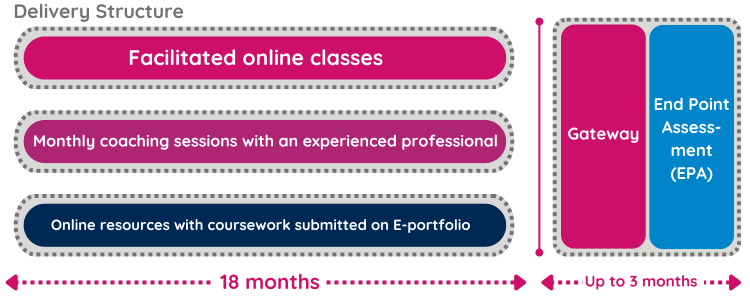
The apprenticeship is designed to fit around learners’ existing roles, allowing them to develop specialist skills and knowledge while applying their learning directly in their day-to-day work.
- Facilitated online sessions
Regular virtual classroom sessions support learners to develop the knowledge, skills and behaviours required for the role, with opportunities to reflect on learning and its impact in practice. - Monthly coaching with an experienced practitioner
Learners receive ongoing support from an experienced practitioner, helping them apply their learning in the workplace, review progress and develop confidence in their specialist role. - Online learning and portfolio development
Learners access structured online resources and complete activities throughout the programme, building a portfolio of evidence that demonstrates their impact in supporting pupils.
Assessment
Gateway
Gateway is the final stage of the apprenticeship before assessment, where the employer and training provider confirm that the learner has developed the required knowledge, skills and behaviours and is ready to move forward to End Point Assessment.
End Point Assessment (EPA)
EPA is the final assessment of the apprenticeship and includes:
- Observation with questions, where the learner is assessed in their real working environment
- Professional discussion, supported by a portfolio of evidence built throughout the programme
The outcome of the EPA determines the final grade of pass, merit or distinction.
Related Courses and Content