

At a glance

Course duration
14 Months + Assessment

Early Intervention Practitioner
(Level 4)

Expert support from your personal Apprenticeship Tutor

Specialist training in early intervention, safeguarding and more

Monthly Coaching
Sessions

Free for learners - funded via Growth and Skills Levy
Price for this programme: £5,000 £0
This course is fully funded through the Growth and Skills Levy
What is the Pastoral Support Practitioner Apprenticeship?
This programme is for staff who support pupils facing barriers to attendance, behaviour, wellbeing and inclusion. It is designed for those working with pupils and families to identify needs early, strengthen engagement and coordinate effective support before issues escalate.
The programme builds specialist knowledge and practical skill in early intervention, family engagement, safeguarding and multi-agency working. Learners develop the confidence to assess needs, work effectively with external services and put evidence-informed support in place for pupils and families.
Through the programme, schools can strengthen internal capacity to respond to complex needs and demonstrate inclusive practice aligned with Ofsted and sector priorities.
Watch the webinar 👇
Designed around real school priorities
This programme was developed after speaking directly with MATs and schools about the challenges facing pastoral and inclusion teams. They told us they needed practical, applied training to support attendance, behaviour, family engagement, early intervention and vulnerable pupils.
What schools told us matters most
Schools consistently highlighted the same pressures and priorities:
- Improving pupil attendance
- Supporting vulnerable pupils earlier
- Managing behaviour and de-escalation
- Strengthening family engagement
- Reducing exclusions and improving reintegration
- Supporting SEND pupils effectively in mainstream settings
- Identifying concerns early through data and case management
- Developing staff confidence in safeguarding and complex pastoral situations
Many schools also shared that pastoral staff are often “accidentally in role” without specialist training, and that existing CPD rarely focuses on practical pastoral and family support work.
A programme built around practical school realities
Every aspect of the programme has been designed to reflect the day to day demands of pastoral and inclusion roles.
Practical, applied learning
Schools asked for training that could be used immediately. The programme focuses on real scenarios, case studies and practical interventions rather than theory-heavy content.
Behaviour and early intervention
Because schools identified behaviour support, de-escalation and early intervention as major priorities, these themes are embedded throughout the programme.
Family engagement and complex casework
Schools told us staff need greater confidence working with families and managing complex situations. Learners develop strategies for difficult conversations, multi-agency working and sustained pastoral support.
Attendance, safeguarding and inclusion
The curriculum directly addresses the areas schools rated as most important, including attendance improvement, safeguarding in practice and inclusive support for vulnerable pupils and SEND learners.
Real school caseloads and decision making
Schools wanted staff who could manage real situations under pressure. Learners build confidence through reflective practice, case management activities and workplace-based projects linked to their own setting.
Consistency across MATs and teams
MATs highlighted the importance of consistent approaches across schools. The programme provides shared language, systems and approaches that support trust-wide pastoral practice.
Who can apply for the Pastoral Support Practitioner Apprenticeship?
This apprenticeship is suited to school staff working directly with pupils and families to address barriers to learning, attendance and engagement.
Typical roles include:
- Pastoral Lead
- Attendance Officer or Attendance Lead
- Behaviour Support Lead
- Inclusion Officer
- Family Support Worker
- Pastoral Manager or Head of Year
- Pupil Welfare Officer
- Safeguarding or Pastoral Support Officer
What are the outcomes of the programme?
Early identification and intervention
- Spot early warning signs in attendance, behaviour and wellbeing
- Assess needs and take timely, appropriate action
Working with pupils and families
- Build trust and positive relationships
- Communicate effectively with parents and carers
- Support engagement with school
Safeguarding and risk management
- Carry out risk assessments
- Make appropriate safeguarding referrals
- Work confidently within safeguarding frameworks
Multi-agency working
- Work with early help, SEND teams and local services
- Coordinate support around the pupil and family
Data and record keeping
- Maintain accurate, high quality records
- Use data to inform decisions and demonstrate impact
Behaviour and attendance support
- Apply restorative and relational approaches
- Support improved attendance and positive behaviour
Programme content
Learners develop the knowledge, skills and behaviours needed to support pupils and families effectively through early intervention.
Key Areas include:
- Identifying early warning signs in attendance, behaviour and wellbeing
- Building positive relationships with pupils and families
- Communicating effectively with parents and carers
- Carrying out risk assessments and safeguarding referrals
- Working with multi agency services including early help and SEND teams
- Assessing needs and selecting appropriate interventions
- Managing a caseload and prioritising support
- Using restorative and relational approaches
- Maintaining accurate records and using data to inform decisions
Programme Structure
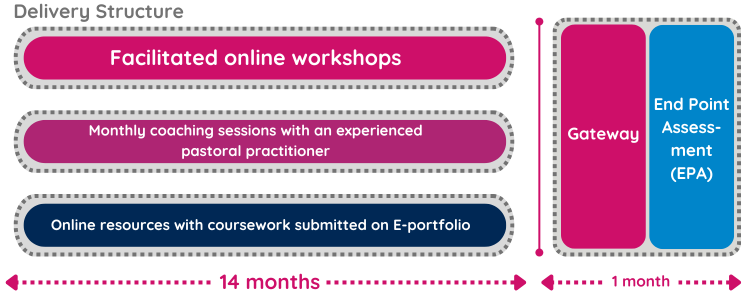 The programme is delivered through a mix of online learning, live workshops and workplace application across 14 months.
Online learning
Self paced learning that introduces key topics such as early intervention, safeguarding, family engagement and case management.
Live workshops
Interactive sessions that help apprentices explore real situations linked to attendance, behaviour, wellbeing and inclusion.
Group coaching
Regular sessions that help apprentices reflect on their work, discuss pupil support challenges and stay on track with their workplace learning.
Personal support
Each apprentice receives support from a personal Apprenticeship Tutor, with regular reviews, feedback and guidance throughout the programme.
Will this apprenticeship help to ensure that my school is aligned with Ofsted priorities?
Ofsted’s Education Inspection Framework (EIF) sets out the key judgement areas used in inspection: see Quality of Education, Behaviour and Attitudes, Personal Development, and Leadership and Management.
This apprenticeship helps schools strengthen the practice behind those specific judgement areas by developing staff who can:
Identify needs early (Quality of Education, Behaviour and Attitudes)
Supporting early identification of barriers to learning, attendance and wellbeing, which underpins pupils’ ability to access the curriculum
Improve attendance and behaviour (Behaviour and Attitudes)
Putting consistent, effective support in place to improve attendance, engagement and conduct
Build stronger relationships with parents and carers (Leadership and Management, Personal Development)
Strengthening communication and partnership with families to support pupil development and wellbeing
Make confident safeguarding decisions (Leadership and Management)
Ensuring staff can assess risk, act appropriately and contribute to a strong safeguarding culture
Support vulnerable pupils and those with additional needs (Quality of Education, Personal Development)
Promoting inclusion and ensuring all pupils are supported to participate fully in school life
Coordinate support across services (Leadership and Management)
Working effectively with early help, SEND teams and external agencies to meet pupil needs
In practice, this means schools can demonstrate the behaviours Ofsted looks for within each judgement area: identifying needs early, taking effective action and creating an environment where pupils feel supported, included and able to thrive.
Am I eligible for the Pastoral Support Practitioner Apprenticeship?
To apply, learners must:
- Be employed in a school or education setting
- Be working in a role supporting pupils and families
- Have the support of their employer to complete the apprenticeship
- Meet standard apprenticeship funding and eligibility requirements
.png)
Related Courses and Content