

At a glance

Course duration
12 Months


Awards:
NPQLBC and
Level 4 Project Manager Apprenticeship

Face-to-Face Events
3

Monthly Coaching
Sessions

Programme cost
£7,000 £0 with Growth and Skills Levy funding
What is the Leader Apprenticeship with NPQLBC?
The Leader Apprenticeship with NPQLBC is a dual award which has mapped the DfE's NPQ for Leading Behaviour and Culture (NPQLBC) to the Level 4 Associate Project Manager Apprenticeship.
The NPQLBC provides an evidence-informed framework built around “learn that” and “learn how to,” defining what effective leadership of behaviour and culture looks like in practice. It focuses on creating a calm, safe and predictable environment by establishing consistent school-wide systems and supporting staff to manage pupil behaviour effectively.
The apprenticeship develops participants as skilled project leads, capable of planning, executing and monitoring complex initiatives. It provides the structured methodology needed to manage resources, mitigate risks and lead teams through the lifecycle of a school-improvement project.
This combination means leaders develop as strategic leaders who can shape whole-school practice, culture and performance.
Who is the Leader Apprenticeship with NPQLBC for?
The Leader Apprenticeship with NPQLBC is suitable for teachers who have, or are aspiring to have, responsibilities for leading behaviour and/or supporting pupil wellbeing in their school.
Leading behaviour and culture is complex and professionals looking to lead in this area need to have expertise across a number of specialist areas related to their role (e.g. behaviour systems) and in approaches that, through working with their colleagues, enable their school to keep improving (e.g. professional development and implementation).
What are the benefits of completing the Leader Apprenticeship with NPQLBC?
This dual-award programme bridges the gap between behavioural theory and daily practice. While the NPQLBC provides the evidence-informed framework for "what" a positive school culture looks like, focusing on high expectations and consistent system, and the Level 4 Project Manager Apprenticeship provides the "how."
By embedding the NPQLBC into the Level 4 Project Manager Apprenticeship, you move from simply understanding behaviour to actively leading it. This partnership ensures that behavioural shifts are sustained through project management tools and performance monitoring, creating a predictable, calm environment where both staff and pupils can thrive.
Develop your skills and knowledge
Become adept in ensuring good behaviour and a culture of high expectations and learning are maintained across the school. Develop expertise across a number of specialist areas related to the role such as behaviour systems.
Personalised feedback and coaching
Benefit from additional support and monthly coaching sessions, providing you with personalised guidance and insights tailored to your unique situations, helping you overcome any challenges you may face.
Evidence-led culture
Make evidence-based decisions to implement proven behaviour management processes and a culture of high expectations within your school.
Leading Change with Empathy
Use Change Management principles to guide your team through new pastoral initiatives while maintaining morale.
Evaluate impact and improve outcomes
Refine your ability to monitor progress and manage risks before they impact school climate. Use project data to evaluate the effectiveness of your interventions, allowing for evidence-based adjustments that improve outcomes for pupils and staff.
Establish a purposeful and safe school culture
Gain a deep understanding of the evidence regarding school culture and pupil behaviour. Learn how to implement consistent systems and routines that allow all pupils to feel safe and all teachers to teach without disruption.

Why should I undertake the dual award?
.png)
Cross-sector learning
Candidates access cutting-edge theory, resources and delivery from thought leaders and leading practitioners from all sectors of the economy.
.png)
Awards 40 Master's credits
Can be used as a springboard onto an MA in Educational Leadership with the University of Chester.
.png)
Practice-based programme
Candidates undertake school-based activities and are assessed on how they apply learning in their day-to-day role, helping develop and refine organisational management and leadership skills.
.png)
A wider view of leadership
Candidates apply cross-sector management and leadership practice to their school context providing greater challenge and a broader perspective to organisational improvement.
.png)
Access to extra coaching and content
Throughout the course you will have access to coaching and teaching to help you succeed in the qualification.
.png)
A personal experienced tutor to help you
An experienced tutor will help you throughout both the apprenticeship and the National Professional Qualification.
.png)
Utilise levy funding
This professional development opportunity makes use of the Growth and Skills Levy and includes the DfE accredited NPQLBC at no additional cost.

BPN Boost
From additional support, guidance and opportunities, BPN Boost enhances the apprenticeship journey beyond the core curriculum.
This programme focuses on the holistic development of the appropriate skills, knowledge and behaviours, designed in partnership with cross-sector industries, to ensure bespoke coverage of all the relevant requirements of leading and managing at a senior level at your setting.
The Leader Apprenticeship with NPQLBC makes use of a blended delivery model consisting of Face-to-Face events, online study, webinars and coaching.

Face-to-Face
Learners will attend 3 face-to-face events via the blended delivery model. Our nationwide delivery partnership network allows us to bring face-to-face training to a school near you and facilitated by local school leaders.

Online Learning
Participants access online learning and support via our virtual learning environment (VLE) BUD. Through BUD, participants are able to engage with their learning communities of peers and access multimedia content. They can also access research and expert-led school practice aligned to the curriculum content for the qualification, receive high-quality feedback from experienced performance coaches and submit work for assessment.
How do I access the funding?
The Leader Apprenticeship with NPQLBC can be funded through your school’s Growth and Skills Levy. Schools will be able to access the funding through their apprenticeship service (AS) account.
If your school needs help setting up your AS account, just let us know and we’ll guide you through it.
The Leader Apprenticeship with NPQLBC costs £7,000 from Growth and Skills Levy funds or co-investment for non-levy payers where the government pays 95%.
The level of funding depends on each candidate’s learning needs, with a maximum allocation of £7,000 to cover the cost of the apprenticeship.
What is the Growth and Skills Levy?
The Growth and Skills Levy (previously the Apprenticeship Levy) is paid by large employers with a wage bill of over £3 million. These employers pay 0.5% of their total annual pay bill into the levy. Most state-maintained schools and multi-academy trusts pay into the levy.
The levy is designed to create long term sustainable funding for apprenticeships and to give employers more control to provide their staff with a range of training opportunities.
From the 1st of August 2026, there are some changes to apprenticeship funding:
For levy-paying schools:
- Unused levy funds now expire after 12 months (previously 24)
- For levy-paying schools that have exhausted their funds, the government will fund 75% of the cost (£5,250), with your school contributing the remaining 25% (£1,750)
Can non-levy paying schools still access funding?
Yes. For adult learners aged 25 and over, the co-investment rate remains at 5% (£350), with the government paying the remaining 95% (£6,650). The government has removed co-investment costs entirely for apprentices aged 16 to 24 from non-levy paying settings.
Applicants must have full support from their school/organisation. A head teacher, member of the SLT, line manager or Chair of Governors (or similar authoritative role) must confirm their support and that all information submitted is true and correct. This is a Department for Education mandatory requirement.
To apply, applicants must have the following:
- 2 years teaching experience
- Leadership aspiration/experience
- A Teacher Reference Number (TRN) will also be required to obtain a DfE accredited certificate upon successful completion of the programme. Applicants will be supported to obtain their TRN during the registration process if they do not already have one.
If you are unsure if you meet the above requirements or have other relevant experience then please contact our team who will be able to support your application.
You won't be facing this journey alone. From your very first day, you'll be part of a supportive network:
- Your Sponsor: A senior leader within your setting (such as your Headteacher or Chair of Governors) provides crucial support by formally declaring their commitment to your development and allocating you an Apprenticeship Mentor.
- Your Apprenticeship Mentor (AM): A colleague from your school will take on a dual role, combining the core responsibilities of an Apprenticeship Mentor with the developmental support traditionally provided by an NPQ In‑School Performance Coach (ISPC).
This means the mentor will guide the apprentice through regular workplace engagement, on‑the‑job learning and progress reviews as part of the apprenticeship, alongside delivering structured coaching, challenge and developmental feedback aligned to NPQ requirements.
Through planned coaching sessions, discussion of formative assessment tasks and ongoing monitoring of progress, the mentor will help participants reflect on their leadership growth and evaluate the impact of their learning on their school.
- Your Apprenticeship Performance Coach (APC): Your APC will be your primary point of contact throughout the programme. They will offer feedback on task submissions, support you when you are gathering evidence for the portfolio and coach you during the tripartite review meetings with the AM.
- Face-to-Face Event Facilitators: Expert facilitators lead engaging Face-to-Face events, fostering learning and networking opportunities with other leaders.
Off‑the‑Job Training (OTJT) is the time you spend developing new skills, knowledge and behaviours that directly enhance your effectiveness as a team leader, and reflects the learning you apply within your day‑to‑day role. As required by the Department for Education, every apprenticeship standard has a set minimum number of OTJT hours that must be delivered. Activities could include:
Operational Planning & Performance
Activities that help build skills in planning, monitoring performance and understanding organisational priorities, such as:
- Creating or refreshing team KPIs, dashboards or scorecards
- Reviewing performance data with new analytical tools or methods
- Contributing to operational plans, rotas, workflows or staffing models
- Designing or updating standard operating procedures (SOPs)
- Participating in meetings focused on planning improvements or monitoring progress
Leading People & Team Management
Development activities that strengthen leadership skills:
- Coaching or mentoring sessions with staff
- Leading or co‑leading team meetings, stand‑ups or briefings
- Planning or delivering training for colleagues
- Supporting colleagues through change projects or new initiatives
- Facilitating feedback or performance conversations using new models
Personal Development & Reflective Practice
Activities that help build confidence and self-awareness:- Completing reflective journals or learning logs
- Attending workshops, webinars, inset days or CPD sessions
- Shadowing leaders in other departments or roles
- Participating in peer learning groups or communities of practice
Building Relationships & Communication
Tasks that deepen understanding of communication and collaboration:- Leading cross‑team discussions or working groups
- Preparing and delivering team presentations
- Practising communication techniques learned in workshops
- Working with internal or external stakeholders to solve problems
Managing Change & Continuous Improvement
Practical involvement in organisational development:- Supporting a change management project
- Gathering team feedback and contributing to improvement plans
- Conducting research or benchmarking best practice
- Trialling new processes and reporting on outcomes
Knowledge-Building & Research Activities
Activities that broaden understanding of leadership, governance and organisational contexts:- Researching legislation, policies, or industry updates
- Studying leadership models or management theory
- Preparing for assessments, revision, or consolidation tasks
- Reviewing organisational policies and exploring how they apply to team practice
Below is the programme structure for the Leader Apprenticeship with NPQLBC: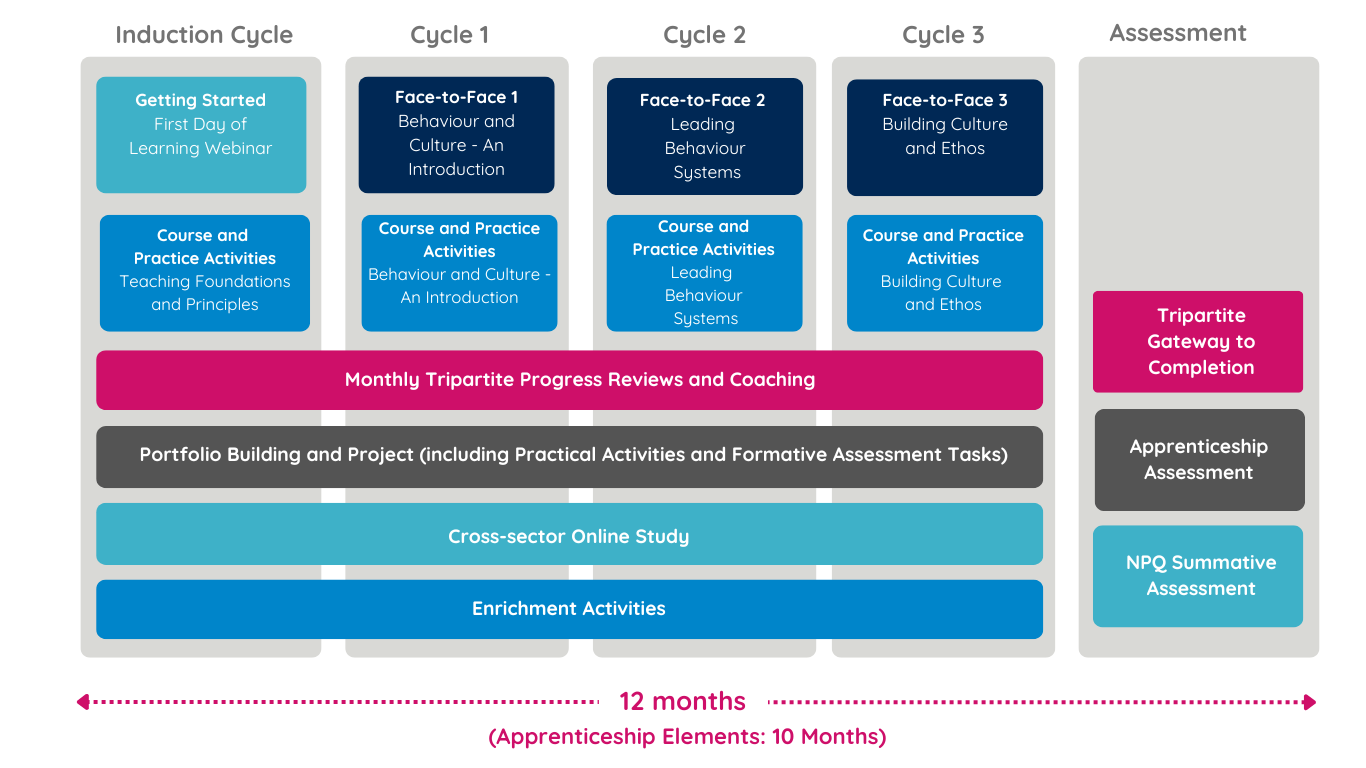
Related Content