

.png)
.png)
No Cost to Trainee or School

Course Duration
up to 12 months

Awards Early Years Teacher Status

Trainees Count Towards Ratios

Eight Live
Training Days

Online Training & Setting Placements
Why EYITT Foundation stage?
Early Years Initial Teacher Training has always had strong uptake in PVI settings, but school-based nursery, Reception and Foundation Stage teams have not always accessed the programme in the same numbers.
That is a missed opportunity because EYITT directly supports the priorities at the heart of school-based early years provision, including strengthening Nursery and Reception practice, improving transition into school and building stronger links with local PVI settings.
EYITT Foundation Stage was specifically designed to be suitable for a wide range of school-based early years staff, including Reception teachers, nursery teachers, early years TAs, HLTAs, LSAs, nursery leads, practitioners and unqualified teachers working across the Foundation Stage.
Developing early years expertise in schools
Training is grounded in the Statutory Framework for the Early Years Foundation Stage and prepares trainees to meet the Teachers’ Standards Early Years. Practitioners develop specialist knowledge of child development, communication and language, early literacy and play based learning, helping schools secure strong outcomes across all seven areas of learning and development.
Trainees spend the majority of their training within their own school setting while completing a short placement in a PVI or group-based setting to gain experience across the full 0 to 5 age range and strengthen understanding of children’s experiences before school.
The programme leads to Early Years Teacher Status, giving practitioners formal recognition as graduate level early years specialists and providing schools with a clear pathway to develop internal expertise across Nursery and Reception.
Developed with experts from Best Practice Network, Thrive and LMP Group, EYITT Foundation Stage reflects the realities of school based early years delivery while supporting a clear understanding of how early learning connects to Key Stage 1.


Who is the EYITT Foundation Stage pathway for?👇
This pathway is designed for graduates working in school based early years provision, including:
- Teaching assistants including TA, HLTA and LSA roles
Gain the knowledge and confidence to take a more active role in planning, teaching and supporting children’s development in Nursery and Reception - Early years and nursery practitioners in primary schools
Build on your existing experience and gain Early Years Teacher Status while continuing to develop your practice within your setting - Unqualified teachers delivering Nursery or Reception provision
Achieve a recognised graduate level qualification and strengthen your understanding of the EYFS and early years pedagogy - Qualified teachers looking to gain specialist early years expertise
Develop a deeper understanding of early development and enhance your ability to lead high-quality provision in Nursery and Reception - Foundation Stage leads
Strengthen your leadership of the EYFS, with a clearer understanding of curriculum progression and transition into Key Stage 1 - Leaders and managers overseeing school nursery provision
Develop the expertise needed to improve the quality of provision, support staff development and drive stronger outcomes for children - Apprentices/ support staff working across Nursery and Reception
Progress your career with a clear pathway into early years teaching, while building practical experience in your current role
Build ties with local nurseries through a placement 👇
A structured placement in a private, voluntary or independent (PVI) setting is a core part of EYITT Foundation Stage. Far from being an administrative requirement, it gives schools a practical opportunity to build stronger relationships with local nurseries that feed into Reception.
Recent Department for Education guidance highlights that successful transition into Reception depends on schools and early years settings working together as “a connected community”, supported by “joint transition events, shared stay-and-play sessions and reciprocal visits”. The guidance also stresses the importance of reciprocal visits and meaningful collaboration between schools and early years providers to create continuity for children moving into Reception. The EYITT Foundation Stage placement directly supports this priority.
Through placement activity, schools can:
- Build relationships with local feeder nurseries and childminders
- Develop a stronger understanding of children’s experiences before school
- Improve transition conversations and information sharing
- Create greater consistency between nursery and Reception practice
- Strengthen early identification of need through collaborative working
- Develop ongoing professional links beyond the placement itself
How is EYITT Foundation Stage delivered? 👇
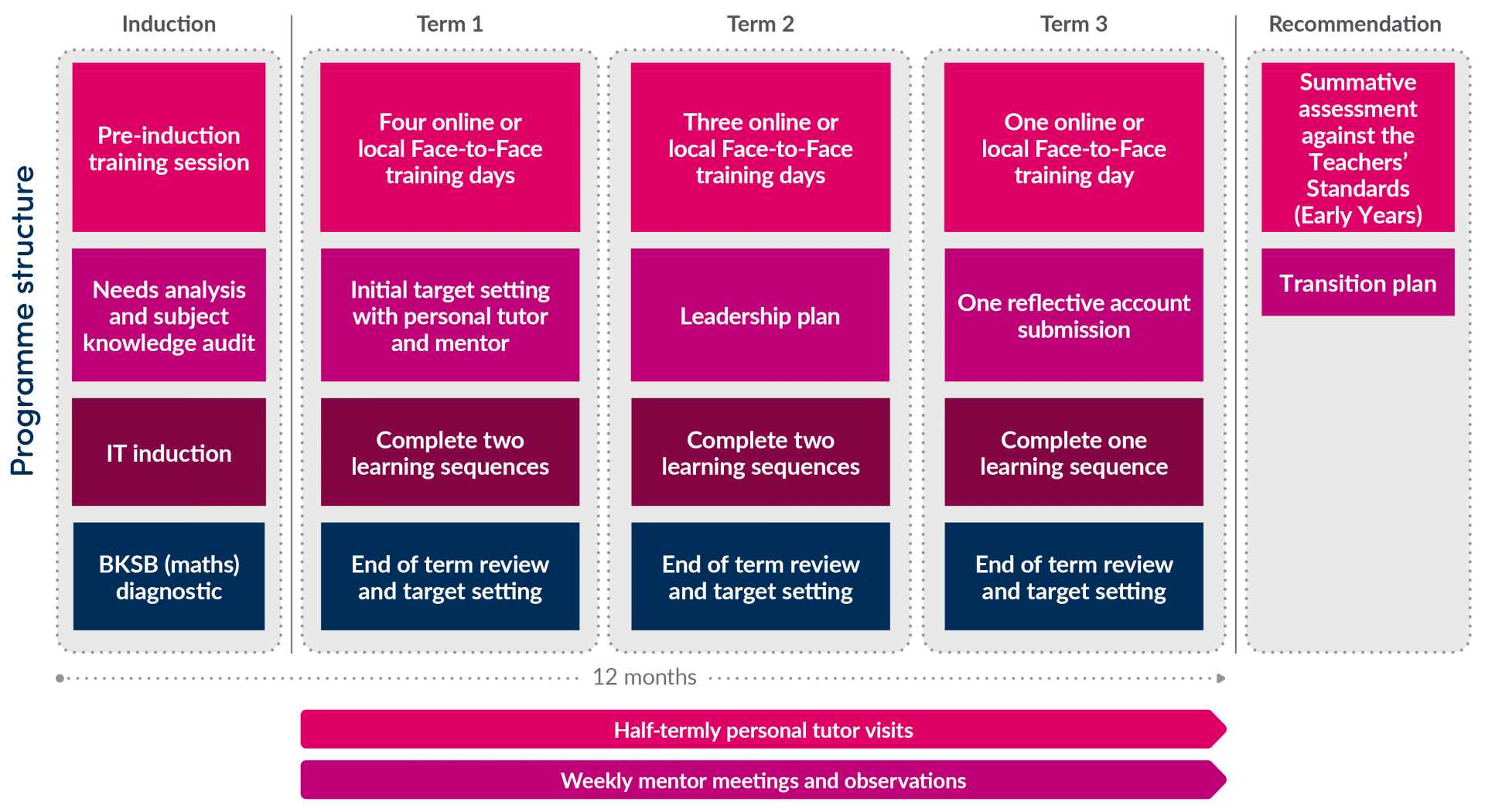
Student teachers attend eight virtual or face-to-face training days, complete self-paced online study and gain additional experience through a structured placement in a local PVI setting.
Through placement activity, schools can:
- Training days: student teachers attend live online or locally facilitated training days usually one each month spread across the programme
- Structured PVI placement: a minimum 25 day placement in a private, voluntary or independent early years setting to broaden understanding of children’s experiences before school and strengthen transition into Reception
- Self-paced online study: flexible learning designed to build knowledge between live sessions and support application within school based EYFS practice
- Enhancement webinars: additional sessions covering topics such as child development, communication and language, school readiness and transition into Reception
- Personal tutor: dedicated 1:1 support from an expert in school based early years provision throughout the programme
- Mentor and lead trainer: support from experienced colleagues within your school or setting to help connect learning directly to day-to-day practice
- Assessment: completed through an ePortfolio including observations, reflective practice, action plans and evidence against the Teachers’ Standards Early Years
- Focused on real classroom practice: training is designed around the realities of working in Nursery and Reception, helping practitioners apply learning immediately within their setting
What will I learn? 👇
EYITT Foundation Stage is designed to help student teachers build specialist knowledge of the Early Years Foundation Stage and apply it directly within school based Nursery and Reception provision.
Throughout the programme, student teachers develop the subject knowledge, professional skills and behaviours needed to become Early Years Teachers. They also explore how high quality early years practice supports children’s development from birth to five, strengthens transition into Reception and builds strong foundations for future learning in Key Stage 1.
Below is a list of topics covered during the training days:
- Training Day 1: The Effective Early Years Teacher
- Training Day 2: Adapting Teaching for the Unique Child
- Training Day 3: Starting Strong
- Training Day 4: Foundations for Success
- Training Day 5: Leading and Supporting in the Early Years
- Training Day 6: Promoting Equality, Diversity and Inclusion
- Training Day 7: Unlocking Potential and Widening Opportunities
- Training Day 8: The Reflective Early Years Teacher
- Final Interview: EYTS recommendation
T
What are the benefits for learners? 👇
- A strong understanding of the transition from EYFS into Key Stage 1 and wider curriculum expectations
- In-depth knowledge of early development, including communication and language, pre-phonics, PSED and physical development
- Greater confidence delivering high-quality provision within a school based nursery or reception setting
- The ability to contribute to wider school priorities and curriculum coherence
- Opportunities to connect with other practitioners working in school based early years settings
What are the benefits for schools? 👇
EYITT Foundation Stage supports schools to strengthen the quality of their early years provision in line with DfE expectations.
Schools benefit from:
- Graduate level Early Years Teachers who meet national Teachers’ Standards Early Years
- Improved quality of education in Foundation Stage 1 (Nursery) and Foundation Stage 2 (Reception)
- Strong foundations in communication, language and early literacy
- Earlier identification of SEND , better targeted support, reduced long‑term intervention costs
- Greater consistency between Nursery, Reception and Year 1
- Increased leadership capacity within the Foundation Stage
- A structured workforce development pathway for existing staff improving consistency and quality across EYFS.
The programme supports schools to deliver a high quality EYFS curriculum that ensures stronger early foundations, improved progress across EYFS, and better readiness for Key Stage 1.
Early Years Webinars
Join our upcoming webinars and watch recordings of past sessions designed to support early years professionals.
Stay up to date with training opportunities, funding guidance and practical insights from our experts.
Register or watch now →
Meet The Team
Why choose Early Years Initial Teacher Training (EYITT) with Best Practice Network?
Best Practice Network is the largest provider of Early Years Initial Teacher Training (EYITT) in England, offering reliable training and support. Here’s why you should choose to study with us:
- Experienced and trusted
We have been delivering EYITT since its creation in 2013 and previously ran Early Years Professional Status (EYPS) from 2006, giving us nearly two decades of expertise in early years teacher training! - Proven results
We have a 100% pass rate, showing our commitment to helping every trainee succeed - Over 2,000 successful early years teachers
More than 2,000 trainees have gained Early Years Teacher Status (EYTS) with us, making a difference in early years education - Flexible learning options
Our programme is designed to fit around your schedule, with access to online learning through our Virtual Learning Environment (VLE), as well as the choice of local Face-to-Face or remote training days
Don't take our word for it! Check what our trainees and graduates say...
To be eligible for Early Years Initial Teacher Training (EYITT), you must meet the following entry requirements set by the Department for Education (DfE):
- GCSE Grade C/4 or above (or recognised equivalent) in English, maths, and science. Equivalency exams are accepted if you do not have GCSEs
- Bachelor's degree in any area of study
- Right to study and work in the UK
- Competence in spoken and written English
Prospective EYITT candidates must attend an interview to assess their suitability and readiness for the programme. Interviews are conducted remotely via Zoom or phone call.
BPN Exclusive! FREE maths equivalency testing!
If you need an equivalency test in maths we are currently offering it for FREE to all prospective candidates who are successful at the interview and accept their conditional offer to join the September Intake of the programme.
So, if you don't have a GCSE in maths and need an equivalency test, we are the only training provider offering this test, which would normally cost between £100 - £250, free of charge to our prospective trainees.
This test is to join EYITT with BPN and will not be honoured by other training providers.
Why train your graduate practitioners to become Early Years Teachers?
Research has shown that employing graduate-trained staff improves teaching standards and has a positive impact on the whole setting. Early Years Initial Teacher Training (EYITT) is fully-funded by the Department for Education (DfE) as a part of Government's recovery plan.
- Free training: EYITT is fully funded, meaning no cost to you or your practitioners
- Employer incentive: Receive a £7,000 bonus, paid in instalments, to help cover the costs associated with having a trainee on the programme. Please see here for the BPN details and visit the DfE website for funding guidance
How can you support your employee?
Documents required at the application stage
- Completed Employer Declaration, which we will email to you once your trainee applies for a place on the programme
On-programme support
- Time allocation: Employment-based trainees should have no more than a 90% timetable of direct work with children, leaving a minimum of 10% release time for planning, reading, assessments, mentor meetings, and written tasks
Mentoring and Support
- Mentor and lead trainer: Appoint a mentor and a lead trainer from within your setting to support the trainee. Mentors help trainees reflect on their practice, develop subject knowledge and professional skills, and monitor the use of the employer incentive to ensure it supports the trainee’s development. For full details, see the role description for mentors and lead trainers.
Mentor and Lead Trainer Responsibilities
Personal tutor
Best Practice Network will assign a personal tutor to your trainee. Tutors and the Quality Assurance (QA) team may visit or arrange remote discussions with the trainee and mentor.
Further information
To understand the commitments of EYITT for both trainees and employers, please watch our employer webinar. For further questions, call us on 0117 920 9200.
Mentors play a vital role in the success of EYITT trainees, guiding and supporting them on their journey to becoming Early Years Teachers. Mentors help trainees reflect on their practice and develop the knowledge, skills, and behaviours necessary to achieve Early Years Teacher Status (EYTS).
Mentor responsibilities: Mentors use their experience and expertise to shape trainees into confident and effective Early Years Teachers.
How to apply?
-
Click the "Apply Now" button above to create an account on our application portal.
-
Complete the application form and upload the required documents. You can save your progress and return at any time.
Our early years team will arrange a remote interview if you meet the eligibility criteria. -
The Quality Assurance (QA) team will conduct the interview to ensure DfE standards are met, with decisions made within three weeks.
-
If successful, you’ll receive an electronic contract and welcome pack with further information and next steps.
FAQs
Equivalency with QTS & teaching in schools
Those with Early Years Teacher Status can work in maintained settings but only individuals who meet the legal definition of a school teacher can lead teaching in a maintained nursery school or a nursery class in a maintained school for children aged 3 and over. Those with Early Years Teacher Status are, therefore, not able to lead classes in a maintained nursery or school, unless they also hold QTS (or a suitable international teaching qualification as defined by NARIC). Early Years Teachers can, of course, lead teaching in all other early years settings.
Early Years Teachers can work in all private, voluntary and independent (PVI) early years settings which is where the majority of children and early years provision is based. They can also work in free schools, academies and independent schools which can employ teaching staff without the requirement for them to have QTS.
There is no pay scale for Early Years Teachers. The pay and conditions of individuals with Early Years Teacher Status are determined by employers. All early years settings including maintained schools are free to set the level of pay for individuals they employ with Early Years Teacher Status
Yes. Some ITT providers offer a 3-7 years Primary QTS route. If you wish to work with children 3+ this may be the best option for you. You can find details on the 'Get Into Teaching' section of the Department for Education’s website.
The government’s reforms are focussed on birth to five as the evidence is clear that high-quality early education teaching and care can have a powerful impact on young children preparing them for school and later life. Although routes to QTS for three to seven years remain, the birth to five years Early Years Teacher route recognises the key importance that quality education has on the outcomes for young children from their earliest years.
Early Years Teachers are specialists in birth to five years and are ideally placed to fulfil the needs of employers in private and independent settings and schools to provide high-quality education and care for our youngest children.
Employment
Initial teacher training leading to Early Years Teacher Status is designed for those who wish to specialise in early childhood development and lead education and care for children from birth to five years. Working as an Early Years Teacher with young children is a rewarding and challenging career and teachers can make a real difference to children’s development and life chances. There are opportunities to work in a range of early years settings to further develop skills and expertise and also opportunities to move into management of a setting.
Early Years Teachers can work in all private, voluntary and independent (PVI) early years settings which are where the majority of children and early years provision is based. They can also work in free schools, academies and independent schools which can employ teaching staff without the requirement for them to have QTS.
For those who wish to work with primary school-age children the most common route to becoming a school teacher is to undertake initial teacher training leading to QTS.
Specialism in early years - birth to five
EYITT leads to Early Years Teacher Status and is for graduates who are already working/have decided to work with babies and young children up to the age of five. This is most important - i.e. you must be committed to teaching, i.e. leading care and education for babies and young children up to the age of 3 as well as for children between age 3 and 5.
If you want to focus only on children age 3+, you should research other ITT options for example 3-7 Primary ITT.
Visit www.education.gov.uk/get-into-teaching to see all the options.
A career in early years brings the rewards of working with young children at a very formative time in their lives and gives the opportunity to make a real difference for young children's learning and life chances. You will be able to also make a lasting, positive impact on children’s wellbeing and development. Working as an Early Years Teacher with young children is a rewarding and challenging career and there are opportunities to work in a range of early years settings to further develop skills and expertise and also opportunities to move into management of a setting. (See section on employment).
Eligibility
Yes, you must be in paid employment doing a minimum of 16.5 hours a week. You can be already employed at the setting/school or employed specifically to join the Graduate Employment-Based route to EYITT.
This is not a route for volunteers at a setting/school. If you are not currently employed or will not be in an employment setting by the time the course starts, you should apply for the Graduate Entry full-time training route - bursaries may be available.
Eligibility and entry requirements are set by the Department for England (DfE). These eligibility and entry requirements are mandatory and cannot be changed or waived.
Yes. As long as your school is inspected the Independent School’s Inspection if not Ofsted inspected, you are eligible to apply and your employer will be eligible for the employer incentive.
Please note your school must follow the Early Years Foundation Stage (EYFS) framework.
Applications from people in this position will be reviewed on a case by case basis and may be eligible for a funded place. When applying you will need to:
- explain your reasons for withdrawing from EYPS/EYITT
- explain how your situation has now changed
- confirm that you are now able to give the required attention to completing the EYITT programme, i.e. if you are offered a place to begin in September.
If you are employed in a setting/school your manager/headteacher will also need to confirm you are now in a good position to complete the programme.
No. Anyone that is registered on the NCTL database as a “not met” for EYPS or EYITT is not eligible for a funded place.
No. EYPS is equivalent to Early Years Teacher Status. Those who have achieved EYPS can refer to themselves as Early Years Teachers. You are not eligible for further funding.
Eligibility for a funded place for those with Qualified Teacher Status is considered on a case by case basis. This is because a qualified teacher already has an equivalent professional teaching Status. It may be possible if you have decided to move from teaching older children to the teaching and care of children from birth to five.
Alternatively, if you have QTS and are very experienced across birth to five and want to achieve Early Years Teacher Status, it is also possible to self-fund the Graduate Entry or Graduate Employment-Based route.
If you are a graduate childminder and can confirm that you have the time to complete all the training requirements you can apply for the Graduate Employment-Based route, however, the £7000 employer incentive may not work in the same way. To be eligible for an employer incentive you must be an employee of the childminding business. If you are a sole trader or business partner and are classed as self-employed by HM Revenue and Customs (HMRC) you would not be eligible for an employer incentive. If your childminding business is a limited company, you and those working for the company are not classed as self-employed and as an employee of the limited company (the employer) you would be eligible for an employer incentive.
It is important that you think through your availability alongside your child-minding commitments because will need to make yourself available for significant time away from your childminding business i.e. for placements of at least 30 days in settings and schools where you will have the opportunity to teach larger groups/classes of children.
You will also need to confirm the ages and numbers of children under five who attend your setting.
If you have evidence of being in a teaching role from a previous employed role within the past two years prior to commencing the training with children up to the age of 5 this may be taken into account.
You must be able to confirm you can arrange for the time to be away from your own child-minding commitments. It is very important that you think this through carefully and can assure us you will definitely be available for placements and training days.
Yes if you are a graduate, you can apply as a teaching assistant. But during EYITT training you will need to be in more than a support role, i.e. have the opportunity to lead the learning and teach children in groups and whole classes.
It is for the individual to consider the most appropriate professional route for them and their career - it would probably help for you to discuss this with colleagues at school.
If a potential trainee teacher wishes to work in a school with older children into Key Stage 1 and not work with babies then teacher training leading to QTS is more relevant. If they wish to work with babies and children under 3 Early Years Teacher Status is more relevant, as QTS does not cover this younger age range.
Ideally, this will not happen - although it is acknowledged that this may be unavoidable for some.
Your new employer will need to agree for you to continue on EYITT and enter into a partnership agreement. If you apply for another job whilst on the EYITT, you should be clear that you are mid-way through the programme in your job application.
Those who are offered a place on the Graduate Entry route will be asked to complete a health questionnaire. If you are currently in employment (the Graduate Employment-Based route), this is an employer responsibility.
The selection process will check your competence in spoken and written English.
For the Graduate Entry route, a DBS check is required.
For the Graduate Employment-Based Route, if you are registered on the DBS Update Service, we will be able to accept your current DBS. However, if you are not registered, you will be required to complete a new DBS check with Best Practice Network.
If you have a masters without a degree, you would have to demonstrate the breadth and time of the academic engagement that would be expected to meet 1st degree study and would not be less than 3 years. If you are a GE candidate, your bursary would be dependent on either your degree (if achieved) or the academic engagement of your masters.
Qualification Requirements
Early Years Teacher Status is a graduate professional Status - at least an ordinary degree* is required on entry to Graduate routes.
All accredited Early Years ITT providers must ensure that all entrants hold a first degree of a United Kingdom higher education institution or equivalent qualification. A first degree comprises an award of 300 HE credit points of which 60 must be at a level 6 of the QCF. Applicants with a foundation degree will need to supplement this qualification with at least 60 credits at level 6 (HE level 3) in order to attain an equivalent qualification before applying for EYITT.
The Graduate Entry and Graduate Employment Based routes both require a degree before beginning the programme.
The only eligible applicants who can apply for these two routes, without an already awarded degree, are those finishing their degree in the summer before the academic year begins, i.e. you will have the degree before beginning the programme in September.
Practitioners who are in the process of topping-up from a foundation degree can apply for a place on the Graduate Employment-Based route to begin once they have achieved a full degree. Applications can be made in advance of being awarded a degree - for September places you need to be completing your degree in the summer beforehand.
* Please note Ordinary degrees (in any subject) are considered on a case by case basis.
Graduates with either ordinary* or honours degrees can apply. For the Graduate Entry route those with a 1st class degree, 2:1 or 2:2 degrees are eligible for a bursary (£5,000 for 1st class, £4,000 for 2:1 or £2,000 for 2:2). Bursaries also apply to Master’s and PhD degrees. There are no bursaries available for those with other classes of honours degree or for an ordinary* degree.
* Please note Ordinary degrees (in any subject) are considered on a case by case basis.
One of the government’s key priorities is to raise the Status and quality of the early years workforce. EYITT Providers are encouraged by the DfE to recruit a high proportion of trainees with good degrees, as for all other ITT routes. Of course, you would also need to demonstrate other entry requirements and suitability to lead the education and care of babies and young children up to the age of five.
The requirements for entry are the same as for all other ITT (QTS) routes. An ordinary degree* is acceptable.
* Please note Ordinary degrees (in any subject) are considered on a case by case basis.
No.
You will need to have been awarded a degree before you can begin EYITT. Early Years Teacher Status, in parallel with Qualified Teacher Status, is a graduate professional status and therefore everyone who is awarded Early Years Teacher Status must have been awarded at least an ordinary degree*.
* Please note Ordinary degrees (in any subject) are considered on a case by case basis.
Yes. We do need to see your certificates or if you have mislaid them, we will also accept a certified statement of results that can be obtained from the examination board. This is a straightforward process. The results slip that is sent before the certificate is not sufficient as these are subject to change. You need a certified statement from the exam board for which they make a charge. If you are unsure how to go about this, then please click on this link to the government's website: https://www.gov.uk/replacement-exam-certificate
If you don’t know your exam board(s), ask a friend or family member who went to your school if they have their certificates and can check for you. If you can contact your school/college they may also be able to tell you.
A letter from your school cannot be accepted as evidence - you need exam board evidence.
You can have either combined Science, Physics, Chemistry or Biology GCSE at grade C or above. Social Science qualifications are not acceptable.
You need GCSE in English Language. We cannot accept GCSE English Literature or spoken English.
You can take a GCSE course at most local colleges.
Alternatively, to enable candidates to meet the GCSE (or recognised equivalent) qualification requirements for the EYITT Programme, Best Practice Network works with Equivalency Testing (EQT), who provide English, mathematics, biology and combined science (biology, chemistry and physics) equivalency tests which are nationally recognised and accepted by colleges, universities and other HEIs.
We will accept equivalency exams taken through the following companies: Equivalency Testing, Birmingham City School of Education and Social Work, a star equivalency and Maths Made Easy
No. Although these are Level 2 qualifications, as are GCSEs, they do not cover the same breadth of knowledge so cannot be accepted as equivalent to a GCSE.
Placements
For the full-time Graduate Entry route, you will need to undertake 120 days placement in at least two settings including 20 days in a reception class and a 5 day Key Stage 1 & 2 placement in a school.
For the part-time Graduate Employment-Based route, placements will be based on an assessment of individual needs. All trainees will need to be able to demonstrate recent evidence of their good teaching and care of children from birth to five across at least two settings, to include 20 days teaching in a reception class and 5-day engagement with Key Stage 1 & 2.
In practice, most GEB trainees need to undertake one or more placements to consolidate their experience across birth to five. The main placement must be of at least 30 days duration. The 30 days can be split into blocks of no less than 2 weeks if this is more convenient. Additional shorter placements may also be necessary to give a current experience of teaching and care across birth to five.
All GEB trainees need experience in a Reception class in school, to gain experience teaching phonics and maths.
See the EYITT Placements Overview for more information
Funding and bursaries
For the Graduate Entry route, funded places are available. There are bursaries available for those with various degrees (£5,000 for 1st class and PhD, £4,000 for 2:1 and Masters or £2,000 for 2:2). There are no bursaries available for those with other classes of honours degree or for an ordinary degree.
For the Graduate Employment-Based route there is £7000 setting grant which employers should use for costs associated with working towards EYITT. (If you are a childminder, please see ‘I am a childminder, am I eligible?’ for further funding information).
There is no set list of activities for the employer incentive. It is intended to contribute towards costs incurred by the employer in supporting and employing the trainee during their training and can be used for things like supply cover; salary enhancements; employment costs, National Insurance and other overheads. This funding should not be used to cover sickness or maternity. Employers should keep auditable information on how this money is spent as we may ask employers to provide this information for the DfE should they request it.
There is no charge to trainees or their employers for the funded Graduate Entry and the Graduate Employment-Based routes as the DfE funds these training routes.
This route is DfE funded for the training fee and what is called an ‘employer incentive’. This will be £7,000 to contribute towards release costs and other support costs while you are on the EYITT programme.
No. As the programme is funded by the DfE it is not listed on the list of eligible programmes for a childcare grant or funding support. The rules for this are set by HMRC
Training Sessions
Training venues will be arranged to be as convenient as possible within the region, taking into account accessibility by public transport. Group training will be approximately once a month.
The Graduate Entry and the Graduate Employment-Based routes run from September to June.
Experience and commitment
The Graduate Entry is a full-time programme. You need to be available on a full-time basis, including 120 full days in placement. This means that you will be required (normally) for four days a week sometimes five, in placement. Your family/other commitments must enable you to be able to commit to full-time attendance.
The Graduate Employment-Based route is part-time, i.e. you undertake the training including placements alongside your employment in an early years setting/school.
The Graduate Employment-Based route is for those in paid employment, so this is not the correct route for you - unless you have secured an employed post for September 2018.
If you do not wish to become employed whilst training you should consider the full-time Graduate Entry route.
Yes. Whichever route you follow this is a necessary requirement - the experience of leading education and care/teaching across birth to five in at least two settings. Previous experience (from the two years before starting EYITT) can be taken into account only if you have evidence of assessed practice, for example, performance management records.
For the Graduate Entry route, your placements will be across at least two settings/schools.
For the Graduate Employment-Based route you need to undertake a forty-day placement ( in blocks of no less than two weeks ) in another setting/school with children within the birth to five age range, as well as Key Stages 1 and 2, during the programme - i.e., if you do not have sufficient evidence of assessed practice in another setting/school.
Yes. This applies to all routes. A minimum of 10 days engagement with the curriculum and expectations in Key Stage 1 & 2 is a necessary requirement. This is completed through study and time spent in school.
Yes. This experience can be recent employment or placement during your EYITT programme.
If experience is from recent employment you need evidence of assessed practice in the previous setting/school. This evidence could come from performance management for example. A record of your experience on its own is not sufficient - you need evidence of the quality of your practice in leading education and care/teaching which evidences the Teachers’ Standards (Early Years).
A minimum of 25-30-days placement experience is required in order for trainees to gain experience of teaching across the 0-5 age range. All age groups must be covered in at least 2 different settings (one is their employment setting) and must be taken in blocks of no less than 2 weeks.
For trainees in an EY setting covering babies, toddlers and pre-school, this will be a placement in a school to include 20 days teaching systematic synthetic phonics and maths in a reception class and 5 days engagement with KS1/2.
**Some trainees will require a 3rd placement e.g. if based in pre-school, they will be required to cover babies and toddlers in addition to the placement in school. This must be sufficient in time (10-15 days per age group) to enable the trainee to complete a sequence of learning, be observed and make an impact demonstrating the Standards**
... I don’t currently have a job in the early years sector. Would I have to find a setting/school who will employ me or does the ITT provider link me up with a setting/school who are employing individuals specifically to complete the programme?
Yes. You can begin employment in an early years setting specifically to undertake the Graduate Employment-Based route. Finding employment could work either way - i.e. you may know of a school/setting that would employ you or the EYITT training provider could assist in this process.
Become an Early Years Teacher - Apply now 👇
Congratulations! You appear to be eligible to apply. Please click the link below to begin your application
Unfortunately, you do not appear to be eligible for this EYITT route. Please contact us using the form below.
Question 2: Do you have a bachelor's degree, or are you in your final year of studying for a bachelor's degree?
Question 3: Are you employed in an Early Years setting or as a Childminder?