

Why Inclusion Matters More Than Ever

Why Inclusion Matters More Than Ever
Written by: Amanda Marsden
Special Educational Needs Coordinator
Best Practice Network
Inclusion is no longer a strand of school improvement that can sit mainly with the SENCO. New policy and inspection expectations place it firmly within whole-school leadership, curriculum design, workforce development and accountability.
For school leaders, inclusion has always been a moral responsibility. It is also a legal duty and, increasingly, a central test of educational quality.
The urgency is clear. Schools are supporting growing numbers of pupils with special educational needs and disabilities (SEND), alongside children affected by disadvantage, poor attendance, mental health needs and disrupted relationships with education.
Families frequently experience delays in securing specialist help, while staff are being asked to respond to increasingly complex needs.
Against this background, inclusion cannot mean simply admitting pupils to a school or placing them in a mainstream classroom. It means removing barriers so that children are present, participate fully, learn well, feel that they belong and are prepared for adulthood.
Recent policy developments reinforce that message. They also require leaders to move beyond statements of intent and examine what inclusion looks like in everyday practice.
 _ Apprenticeship Tutor L7.png)
A system moving towards earlier support
The government’s February 2026 Schools White Paper, Every Child Achieving and Thriving, sets out an ambition to move children from being “sidelined to included”. It presents stronger mainstream inclusion, earlier intervention and improved access to specialist expertise as essential foundations of school and SEND reform. The policy direction is unmistakable: schools will be expected to identify needs earlier, provide more consistent support and work more effectively with families and external professionals.
This builds on the 2023 SEND and Alternative Provision Improvement Plan, which highlighted the problems created by late intervention, inconsistency and an adversarial system. An interim evaluation of the associated change programme, published in January 2026, shows that reform has been tested across partnerships of schools, local authorities and other services.
For leaders, the practical message is not to wait for every detail of a future system. The strongest preparation is to improve the quality of inclusive provision now.
.png)
Inclusion is becoming more visible in inspection
Ofsted’s renewed Education Inspection Framework, introduced in November 2025, includes inclusion as a distinct evaluation area. The state-funded school inspection toolkit, updated for inspections from September 2026, sharpens the focus further.
The update gives greater clarity to inspectors’ consideration of how leaders engage with pupils with SEND and their families. Inspection remains concerned with the impact of leadership systems, not the production of additional paperwork. Schools are not expected to create documents solely for Ofsted.
This distinction is important. An immaculate provision map will not compensate for pupils who routinely miss lessons, receive an unnecessarily narrow curriculum or feel that support is done to them rather than with them. Inclusion must be visible in children’s experiences.
Leaders should therefore ask:
- Are pupils with SEND learning successfully across the curriculum?
- Do adaptations increase access without reducing ambition?
- Are pupils participating in enrichment, trips and wider school life?
- Do families feel heard before relationships reach crisis point?
- Can staff explain the impact of support, rather than merely list interventions?
- Are attendance, suspension and internal exclusion patterns revealing hidden barriers?
These questions are more useful than trying to predict an inspector’s preferred format. They focus attention on the quality of education and the lived experience of pupils.
Inclusion starts with leadership decisions
Inclusive practice is often discussed as though it depends primarily on individual teachers. Classroom expertise is crucial, but the conditions for inclusion are created by leadership decisions.
Timetabling determines whether the SENCO can fulfil the strategic aspects of the role. Curriculum planning determines whether pupils encounter ambitious content or are repeatedly withdrawn from it. Staffing decisions influence whether teaching assistants build independence or create dependency. Behaviour systems can either recognise need and context or unintentionally exclude pupils whose difficulties are expressed through distress.
Leaders must therefore make inclusion a routine consideration in school improvement, financial planning and governance. It should appear in conversations about curriculum, attendance, safeguarding, professional development and outcomes—not only in meetings labelled “SEND”. Financial planning needs considerations, including examples of how schools might invest Inclusion Management Fund allocations – Supporting Education Group (SEG) have resources to support this including the Inclusion Strategy Toolkit.
This does not mean lowering expectations. Inclusion and ambition are not opposites. The aim is to give pupils the teaching, adjustments and support they need to meet appropriately challenging goals.
Choose measures carefully. Success may include stronger attainment, but it may also be reflected in improved attendance, reduced suspensions, greater independence, successful transitions and a stronger sense of belonging.
 _ Apprenticeship Tutor L (1).png)
Build capacity rather than rely on goodwill
Inclusive schools are often sustained by committed individuals doing more than their role reasonably allows. That is not a dependable strategy.
The emerging policy landscape places significant emphasis on workforce capability and collaboration. Leaders should respond with a planned programme of development for teachers, teaching assistants, pastoral staff, governors and senior leaders.
This requires more than one-off awareness sessions. Staff need opportunities to apply learning, review pupil responses, work with specialists and refine practice. SENCOs also need protected time, authority and access to senior decision-making. .
Partnership matters too. Schools cannot resolve every barrier independently. Strong relationships with local authorities, health professionals, social care, alternative provision, other schools and families will be essential if earlier support is to become a reality.
From compliance to belonging
Policy reform may change structures, terminology and funding arrangements, but the most important test of inclusion remains straightforward: what is school like for the child?
Do they feel welcome? Can they access the curriculum? Are their strengths recognised? Are barriers addressed early? Do adults listen? Are they supported to participate, achieve and prepare for the future?
School leaders do not control every pressure facing the SEND system. They can, however, create cultures in which inclusion is treated as a measure of quality rather than an additional demand.
That means placing it at the heart of strategy, investing in staff expertise, listening closely to families and examining evidence with honesty. It also means refusing the false choice between high standards and inclusive practice.
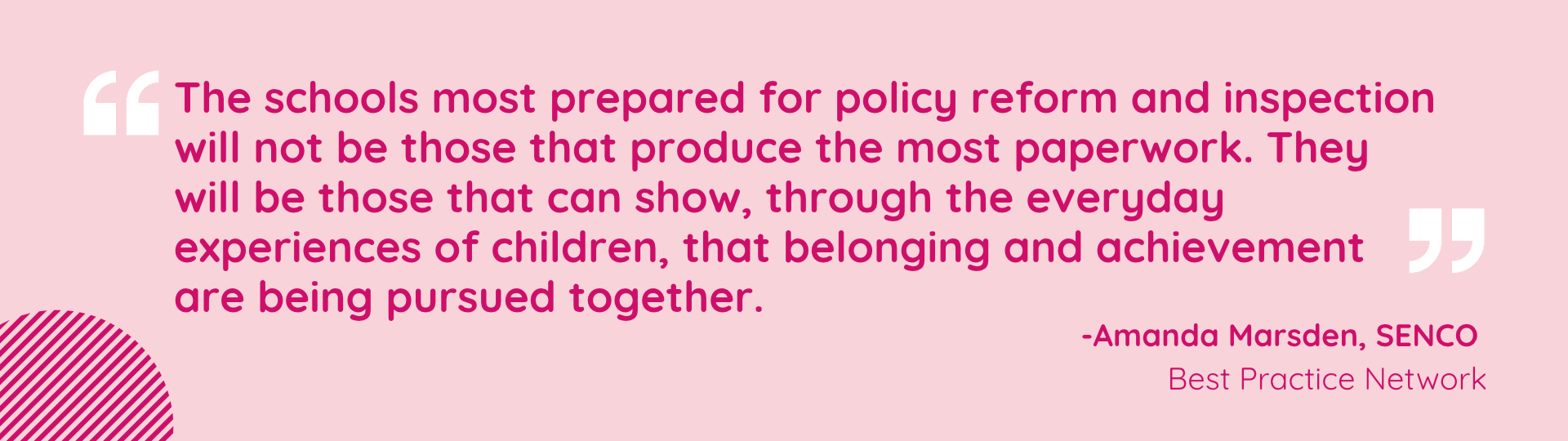
The schools most prepared for policy reform and inspection will not be those that produce the most paperwork. They will be those that can show, through the everyday experiences of children, that belonging and achievement are being pursued together.
Building capability through the SEND Suite
As inclusion becomes an increasingly important measure of school quality, building staff expertise through a whole-school approach is essential. Supporting pupils with SEND can no longer sit solely with the SENCO. Teachers, teaching assistants, pastoral staff and school leaders all have a role to play in identifying needs earlier, removing barriers to learning and creating environments where every child feels they belong. The SEND Suite from Best Practice Network offers a range of apprenticeship programmes designed to help school staff develop the knowledge, skills and confidence needed to strengthen inclusive practice. Explore the full range of programmes and discover how your school can build greater SEND capacity and expertise.